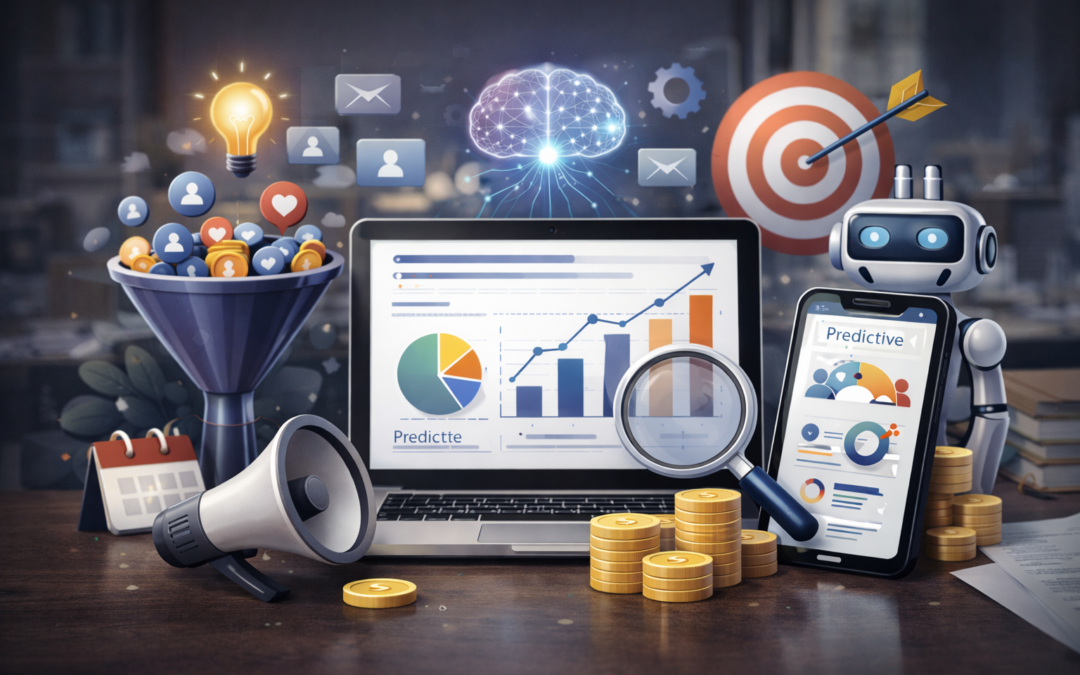
Marketing automation is not new, but the integration of artificial intelligence has fundamentally changed how automation works. What was once a rules-based system designed to save time has evolved into a dynamic, data-driven engine that optimizes campaigns in real time.
AI-powered marketing automation is reshaping how businesses plan, execute, and measure digital campaigns. By combining automation with machine learning and predictive insights, marketers can deliver more relevant experiences while improving efficiency and performance.
What AI-Powered Marketing Automation Really Is
Traditional marketing automation relies on predefined rules. Actions are triggered based on set conditions such as form submissions, email opens, or time delays.
AI-powered marketing automation goes further by learning from data patterns and adapting over time. Instead of relying solely on static workflows, AI analyzes behavior, predicts outcomes, and adjusts messaging, timing, and channel selection dynamically.
This shift allows automation to move from execution support to strategic optimization.
Why AI Is Transforming Automation Now
Several factors are accelerating the adoption of AI-driven automation.
Data volumes have increased significantly across digital channels. Customers expect personalized, timely communication. Competition has intensified, making efficiency and relevance more important than ever.
AI enables marketers to process complex datasets quickly and make decisions at a scale that manual workflows cannot match.
Key Benefits of AI-Powered Marketing Automation
AI-driven automation delivers value across multiple dimensions of campaign performance.
Smarter Personalization at Scale
AI enables personalization based on real-time behavior rather than static segments. Messaging can adapt based on browsing patterns, engagement history, and predicted intent.
This results in experiences that feel more relevant and less generic, even at scale.
Improved Timing and Channel Selection
AI analyzes when users are most likely to engage and which channels they prefer. Emails, ads, notifications, and content recommendations can be delivered at optimal moments.
Better timing improves open rates, click-through rates, and overall engagement.
Continuous Campaign Optimization
Instead of waiting for post-campaign analysis, AI-powered systems optimize campaigns while they are running. Creative variations, audience targeting, and budget allocation can be adjusted in near real time.
This reduces wasted spend and improves return on investment.
More Accurate Lead Scoring
AI-enhanced lead scoring evaluates behavioral signals more effectively than traditional scoring models. This helps marketing and sales teams prioritize prospects based on conversion likelihood rather than basic demographics.
More accurate scoring leads to higher-quality conversations and better alignment between teams.
Common Use Cases for AI-Powered Automation
AI-driven automation is being applied across the digital marketing ecosystem.
In email marketing, AI personalizes subject lines, content blocks, and send times. In paid media, it optimizes bids and audience targeting. In content marketing, it recommends topics and formats based on predicted performance.
Customer journey orchestration is another key area. AI helps coordinate messaging across channels to create cohesive experiences rather than disconnected touchpoints.
How AI Improves Customer Journeys
Customer journeys are rarely linear. AI-powered automation adapts to this reality by responding to individual behavior rather than forcing users through rigid funnels.
When a customer skips steps, revisits content, or disengages temporarily, AI can adjust the journey accordingly. This flexibility improves user experience and reduces friction.
Over time, AI learns which journeys lead to the best outcomes and prioritizes those paths.
Data Requirements for Effective AI Automation
AI is only as effective as the data that powers it. High-quality, well-structured data is essential.
Key data sources include website behavior, CRM data, email engagement, transaction history, and customer support interactions. Integrating these sources creates a more complete view of the customer.
Data governance and accuracy are critical. Inconsistent or incomplete data reduces the reliability of AI-driven decisions.
Challenges and Considerations
Despite its benefits, AI-powered marketing automation presents challenges.
One challenge is transparency. Marketers must understand how decisions are made to maintain control and trust. Another is overreliance. AI should augment human strategy, not replace it entirely.
There are also ethical considerations. Responsible data use, privacy compliance, and clear consent practices must guide automation efforts.
Integrating AI Automation Into Existing Workflows
Successful adoption requires more than technology. Teams need clear goals, training, and alignment.
Start by identifying areas where automation can deliver the greatest impact. Pilot programs allow teams to test AI capabilities without overhauling entire systems.
Collaboration between marketing, data, and IT teams ensures AI tools integrate smoothly with existing platforms.
Measuring the Impact of AI-Powered Automation
Performance should be measured using both efficiency and outcome-based metrics.
Key indicators include conversion rates, engagement quality, cost efficiency, pipeline contribution, and customer lifetime value. Over time, AI-driven automation should reduce manual effort while improving consistency and results.
Continuous evaluation helps refine models and improve performance.
The Future of AI in Marketing Automation
AI-powered automation will continue to evolve. Advances in natural language processing, predictive modeling, and real-time decisioning will further enhance personalization and orchestration.
As AI becomes more embedded in marketing platforms, the distinction between strategy and execution will blur. Marketers will spend less time managing workflows and more time guiding strategic direction.
Balancing Automation With Human Insight
While AI offers powerful capabilities, human judgment remains essential. Creativity, empathy, and strategic thinking cannot be automated.
The most effective marketing teams use AI as a partner rather than a replacement. Automation handles complexity and scale, while humans provide context, vision, and ethical oversight.
Redefining Campaign Performance With AI
AI-powered marketing automation is redefining what effective campaigns look like. Success is no longer measured solely by speed or volume, but by relevance, adaptability, and sustained impact.
By embracing AI-driven automation thoughtfully, businesses can improve campaign performance, deepen customer relationships, and stay competitive in an increasingly complex digital landscape.
Digital marketing has always relied on data, but the way that data is used is changing rapidly. Instead of reacting to past performance, businesses are now using predictive analytics to anticipate customer behavior, optimize campaigns, and make smarter strategic decisions before outcomes occur.
Predictive analytics is transforming digital marketing from a reactive discipline into a proactive one. By leveraging historical data, machine learning, and advanced modeling, marketers can forecast trends, personalize experiences, and allocate resources more effectively. For a deeper look at how predictive analytics helps marketers translate data into forward-looking insights, see Predictive Analytics in Marketing: Turning Data Into Foresighton the Online Marketing Goddess blog.
What Is Predictive Analytics in Digital Marketing?
Predictive analytics uses historical and real-time data combined with statistical modeling and machine learning to predict future outcomes. In digital marketing, this means anticipating customer actions such as purchases, churn, engagement, or conversion likelihood.
Rather than relying solely on what already happened, predictive analytics helps marketers understand what is likely to happen next and why.
Common predictive insights include lead scoring, customer lifetime value forecasting, churn prediction, and content performance forecasting.
Why Predictive Analytics Matters More Than Ever
The digital landscape has become more complex. Customers interact with brands across multiple channels, devices, and touchpoints. Traditional reporting often fails to capture these dynamics in a meaningful way.
Predictive analytics matters because it helps marketers:
Anticipate customer needs and behavior
Improve targeting and personalization
Optimize budget allocation
Reduce churn and increase retention
Make faster, data-backed decisions
Key Applications of Predictive Analytics in Marketing
Predictive analytics can be applied across nearly every aspect of digital marketing strategy.
Lead Scoring and Qualification
Predictive lead scoring analyzes past conversion data to identify which leads are most likely to convert. This allows marketing and sales teams to focus efforts on high-value prospects rather than treating all leads equally.
More accurate lead scoring improves conversion rates and reduces wasted spend.
Customer Lifetime Value Forecasting
Predictive models estimate the long-term value of customers based on behavior patterns. This insight helps marketers prioritize acquisition channels and retention strategies that generate the highest return over time.
Understanding lifetime value also informs pricing, upselling, and loyalty initiatives.
Churn Prediction
By analyzing engagement trends, usage patterns, and behavioral signals, predictive analytics can identify customers at risk of leaving.
Early identification enables proactive retention efforts such as targeted messaging, incentives, or support outreach.
Content and Campaign Performance Forecasting
Predictive analytics helps marketers forecast which content topics, formats, and channels are most likely to perform well.
This reduces trial-and-error approaches and allows teams to plan campaigns with greater confidence.
How Predictive Analytics Improves Personalization
Personalization has become an expectation rather than a differentiator. Predictive analytics takes personalization beyond basic segmentation.
By analyzing behavioral data, marketers can deliver content, offers, and messaging that align with individual preferences and intent. Predictive personalization adapts in real time based on evolving customer behavior.
This results in more relevant experiences that drive engagement and conversions.
Data Sources That Power Predictive Analytics
Effective predictive models rely on high-quality data. Common data sources include:
Website behavior and analytics
CRM and customer data platforms
Email and marketing automation data
Transaction and purchase history
Customer support interactions
The more complete and accurate the data, the more reliable the predictions.
Challenges of Using Predictive Analytics
While predictive analytics offers significant benefits, it also presents challenges.
Data quality is one of the most common obstacles. Incomplete, inconsistent, or siloed data can undermine accuracy.
Another challenge is interpretation. Predictive insights must be understood and applied correctly. Without proper context, predictions may be misused or ignored.
Finally, organizational adoption can be difficult. Teams need training and alignment to trust and act on predictive insights.
Integrating Predictive Analytics Into Marketing Strategy
Predictive analytics should not exist in isolation. It must be integrated into broader marketing workflows.
Successful integration starts with clear objectives. Marketers should define which outcomes they want to predict and how those insights will inform decisions.
Collaboration between marketing, analytics, and leadership teams ensures predictive insights translate into action.
Technology also plays a role. Marketing platforms, CRM systems, and analytics tools must be able to share and activate predictive data effectively.
Measuring the Impact of Predictive Analytics
The value of predictive analytics should be measured through business outcomes rather than technical metrics alone.
Key indicators include improved conversion rates, increased retention, reduced churn, higher customer lifetime value, and more efficient budget allocation. Over time, predictive analytics should contribute to more consistent performance and fewer reactive decisions.
Ethical Considerations and Responsible Use
As predictive analytics becomes more powerful, responsible use becomes increasingly important.
Transparency, privacy compliance, and ethical data practices must guide predictive efforts. Customers should understand how their data is used, and predictions should never feel invasive or manipulative.
Ethical use of predictive analytics builds trust and supports long-term relationships.
Preparing for the Future of Predictive Marketing
Predictive analytics will continue to evolve as artificial intelligence and machine learning advance. Real-time predictions, automated decision-making, and deeper personalization will become more common.
Marketers who invest in predictive capabilities now will be better prepared to adapt as expectations and technologies change.
The future of digital marketing belongs to brands that can anticipate, not just react.
Turning Data Into Strategic Foresight
Predictive analytics transforms data into foresight. It empowers marketers to make informed decisions before outcomes unfold rather than responding after opportunities are lost.
By integrating predictive analytics into digital marketing strategy, businesses can improve efficiency, deepen customer relationships, and drive sustainable growth in an increasingly data-driven environment.
Artificial intelligence has revolutionized digital marketing by automating processes, analyzing massive datasets, and predicting customer behavior with incredible accuracy. At the same time, creativity remains at the heart of campaigns that inspire, connect, and drive action. The true power of modern marketing emerges not from choosing between AI and human creativity, but from blending the two into a partnership that delivers smarter, more effective campaigns.
AI can handle scale, speed, and precision, while human creativity brings empathy, storytelling, and emotional resonance. When these forces work together, brands can produce campaigns that are both highly efficient and deeply meaningful.
Why AI Alone Isn’t Enough
AI is exceptional at identifying patterns and delivering data-driven recommendations. It can optimize ad placements, personalize content, and predict which offers are most likely to convert. However, left on its own, AI risks creating content that feels generic or mechanical.
Customers do not connect with algorithms; they connect with stories, values, and human emotions. Without creativity guiding the process, even the most advanced AI-driven campaign may lack the depth that builds trust and loyalty.
The Role of Creativity in Modern Campaigns
Creativity allows marketers to step beyond data and imagine what customers want to feel, not just what they want to buy. It provides the narrative arcs, visual elements, and cultural relevance that give campaigns their impact. Storytelling, humor, empathy, and design are uniquely human skills that cannot be replaced by algorithms.
At its best, creativity ensures campaigns are not only optimized for clicks but also remembered for their authenticity and originality.
Where AI Enhances Creativity
Instead of replacing creative work, AI amplifies it by removing repetitive tasks and offering insights that free up marketers to focus on innovation. Examples of where AI enhances creativity include:
Content personalization: AI tailors messages to different audience segments, allowing creative teams to design experiences that feel personal.
Idea generation: AI tools can analyze trends and suggest concepts, sparking inspiration for campaigns.
Design and testing: Automated testing allows creatives to experiment with different visuals, copy, and formats without draining resources.
Workflow efficiency: By automating repetitive tasks, AI creates space for creative teams to concentrate on strategy and storytelling.
This partnership ensures that creativity is not constrained by guesswork but supported by real-time intelligence.
Challenges of Combining AI and Creativity
As promising as this intersection is, challenges exist. Overreliance on AI can lead to formulaic campaigns, while neglecting AI altogether may result in wasted resources and missed opportunities. Striking the right balance requires ongoing collaboration between creative teams and data analysts.
Ethical considerations also play a role. Marketers must ensure AI-generated content respects privacy, avoids bias, and maintains authenticity. Transparency about AI’s role in campaigns can help protect brand credibility.
Practical Tips for Marketers
Blending AI and creativity successfully requires more than simply adopting new tools; it demands a deliberate strategy that acknowledges the strengths of both technology and human imagination. Marketers must approach this partnership with the understanding that AI provides the insights and efficiency, while creativity ensures resonance and emotional impact. By recognizing where each excels, teams can avoid the pitfalls of over-automation or overly abstract ideas.
The key is to foster collaboration between data-driven processes and creative storytelling, ensuring that campaigns are both intelligent in design and compelling in execution. To craft campaigns that combine AI and creativity effectively, marketers should:
View AI as a partner, not a replacement, using it to enhance rather than diminish creativity.
Involve both data analysts and creative teams early in campaign planning to align strategy.
Use AI-driven insights to inspire new creative directions while maintaining a human-centered message.
Continuously test and refine campaigns, allowing data to inform but not dictate creative choices.
Keep ethics and transparency at the forefront to maintain trust.
By embedding these practices into campaign development, marketers can ensure their work reflects the best of both worlds—precision powered by data and imagination guided by human creativity.
Looking Forward
The future of marketing lies at the intersection of AI and creativity. As AI technologies grow more advanced, they will continue to provide deeper insights and greater efficiencies. Yet creativity will remain the element that turns those insights into campaigns that resonate on a human level.
By embracing both, marketers can craft smarter campaigns that not only reach audiences but also move them. The blend of data-driven precision and creative storytelling ensures that marketing remains both an art and a science—capable of delivering impact in ways neither AI nor creativity could achieve alone.
The modern customer journey is anything but linear. People move seamlessly between devices and channels—discovering a brand on social media, researching it through a desktop search, and finalizing the purchase from their phone. Each of these moments influences the buying decision, yet many marketers struggle to connect them.
Cross-device and cross-platform attribution solves that challenge. It provides a unified view of how different interactions work together, helping brands understand which touchpoints truly drive engagement and conversions.
Understanding Cross-Device and Cross-Platform Attribution
Cross-device attribution tracks a user’s interactions across multiple devices—such as mobile phones, desktops, and tablets—to understand how those touchpoints contribute to a conversion. Cross-platform attribution goes a step further, connecting engagement across different channels or ecosystems—like email, social media, paid ads, and websites.
The goal is to identify how each marketing channel and device contributes to the user’s path to purchase.
Without this clarity, marketers risk misallocating budgets, overvaluing last-click channels, or underestimating the impact of top-of-funnel engagement.
Why Attribution Matters in Modern Marketing
The consumer journey today spans more platforms, screens, and interactions than ever before.
For example:
A user sees a Facebook ad on their phone.
Later, they search for your brand on Google from their laptop.
They read a blog on your website and sign up for a newsletter.
A week later, they click a promotional email and make a purchase from their tablet.
If your analytics attribute the sale only to the email click, you lose visibility into how much credit should go to the Facebook ad or the search interaction that nurtured the intent.
Cross-device and cross-platform attribution brings balance and insight to this complexity, helping you understand which channels actually influence behavior—and how they work together.
The Challenges of Multi-Device Tracking
While the benefits are clear, accurate attribution across devices and platforms isn’t easy. Marketers face several challenges:
Device Fragmentation
Customers use multiple devices interchangeably. Cookies—traditionally used to track behavior—don’t always carry over between devices or browsers, making it difficult to maintain a single user identity.
Privacy Regulations
With rising data protection standards like GDPR and CCPA, as well as browser restrictions on third-party cookies, collecting and merging user data across platforms has become more complicated.
Platform Walled Gardens
Major digital platforms like Meta, Google, and Amazon often restrict access to their full data ecosystems. These “walled gardens” make it challenging to unify performance metrics across channels.
Attribution Bias
Relying solely on last-click attribution skews performance insights toward bottom-of-funnel channels like paid search or email, undervaluing awareness-building efforts such as display or social media.
Despite these hurdles, new tools and techniques are making holistic attribution more achievable than ever.
Approaches to Cross-Device and Cross-Platform Attribution
There’s no one-size-fits-all model. The best attribution approach depends on your business goals, data maturity, and available tools. Here are some common methods:
Deterministic Matching
This method uses known identifiers—such as logged-in user accounts or email addresses—to link activity across devices. For example, if a user is logged into your app and website using the same credentials, their actions can be unified into one profile. Deterministic tracking is highly accurate but depends on users being authenticated.
Probabilistic Matching
When deterministic data isn’t available, probabilistic models use algorithms to estimate cross-device connections. They analyze patterns like IP addresses, device types, and behavior to predict which devices likely belong to the same user. While not perfect, probabilistic models fill important data gaps.
Multi-Touch Attribution (MTA)
Multi-touch attribution distributes credit for a conversion across all the touchpoints involved in the customer journey. Models such as linear, time decay, or position-based allow marketers to understand how different interactions influence outcomes.
Unified Measurement
Some brands integrate data from multiple platforms and channels into a single analytics environment. Tools like Google Analytics 4, Adobe Experience Cloud, or advanced data warehouses allow businesses to create a unified measurement framework that incorporates both online and offline touchpoints.
Building a Holistic Attribution Framework
An effective cross-device and cross-platform strategy starts with structured planning. Here’s how to approach it:
Centralize Your Data
Bring all customer data—ad metrics, CRM records, website analytics, and offline interactions—into one system. A unified data hub helps eliminate silos and ensures consistency across teams and campaigns.
Use Identity Resolution Tools
Identity resolution technology matches user interactions across devices using both deterministic and probabilistic data. Solutions from platforms like LiveRamp or Segment help consolidate fragmented profiles into a single, accurate customer identity.
Implement Multi-Touch Attribution Models
Move away from single-touch (first or last-click) models and adopt MTA frameworks that give each interaction the weight it deserves. This allows for a more balanced understanding of how each channel contributes to conversions.
Validate with Incrementality Testing
Complement attribution models with incrementality testing—controlled experiments that measure the true lift generated by specific channels or campaigns. This adds a layer of accuracy and confidence to attribution insights.
Ensure Compliance and Transparency
With privacy laws evolving, make sure your tracking practices are transparent, consent-based, and compliant. Clearly communicate how you collect and use data to maintain customer trust.
The Role of AI and Machine Learning in Attribution
Artificial intelligence is transforming how marketers approach attribution. Machine learning models can analyze vast amounts of multi-channel data, detect behavioral patterns, and assign credit dynamically.
AI-driven attribution adapts as user behavior changes—offering more accurate, predictive insights over time. It also helps uncover hidden connections between awareness, engagement, and conversion that human analysis might overlook.
As these technologies become more sophisticated, attribution will evolve from a backward-looking exercise to a forward-looking strategy—guiding not just where to spend, but how to optimize in real time.
The future of cross-device and cross-platform attribution lies in true integration—merging marketing, sales, and customer data to form a single, holistic view of the customer.
Emerging solutions like Customer Data Platforms (CDPs) and advanced analytics ecosystems are helping brands bridge that gap. These systems consolidate identities, automate attribution modeling, and provide marketers with near real-time visibility into the full customer journey.
As privacy standards rise and cookies fade out, the emphasis will shift to first-party data, consent-driven tracking, and smarter algorithms that prioritize both personalization and user trust.
Cross-device and cross-platform attribution isn’t just a measurement tool—it’s a mindset. It encourages marketers to view campaigns not as isolated efforts, but as interconnected experiences that collectively shape the customer journey.
By investing in holistic attribution, brands gain more than performance data—they gain understanding. And in a marketplace driven by attention, that understanding is what truly drives growth.
Automation has changed marketing forever. Tasks that once took hours—sending emails, analyzing data, scheduling content—now happen in seconds. Yet with all this efficiency, something vital is at risk: the human connection that makes marketing meaningful.
Human-centered automation bridges that gap. It combines the speed and precision of technology with the empathy, creativity, and emotional intelligence only people can provide. The result is marketing that feels personal, not mechanical—powered by data, but guided by humanity.
What Is Human-Centered Automation
Human-centered automation is the strategic use of technology to enhance, not replace, human interaction in marketing. It means designing automated systems that reflect empathy, respect, and understanding—ensuring customers feel valued, not processed.
Instead of using automation solely for volume or speed, brands apply it to improve relevance, timing, and personalization. This balance creates marketing that’s both efficient and emotionally resonant.
At its core, human-centered automation asks one key question: Does this automation make the customer’s experience better?
If the answer is yes, it’s aligned with true marketing purpose.
The Importance of Human Touch in Automated Marketing
Automation has undeniable benefits—cost savings, scale, and consistency. But overreliance can make communication cold and generic. Audiences today can sense when messages are mass-produced or impersonal, and they respond accordingly.
The human element is what builds trust. People don’t connect with algorithms; they connect with empathy, storytelling, and authenticity. When brands use automation responsibly, they enhance those human traits instead of erasing them.
Here’s why human-centered automation matters:
It builds trust through authenticity. Personalized interactions show that a brand understands and respects its audience.
It enhances efficiency without losing empathy. Smart automation saves time while keeping communication warm and relevant.
It supports long-term loyalty. Customers are more likely to stay engaged with brands that treat them as individuals, not data points.
Human-centered automation transforms technology from a shortcut into a tool for deeper connection.
Principles of Human-Centered Automation
Balancing technology and empathy requires a thoughtful approach. These guiding principles ensure automation remains human-first.
1. Purpose Before Process
Every automated system should begin with a clear human purpose. Ask: what problem does this solve for the customer? Automation that benefits only the brand (like sending constant reminders) may create short-term engagement but long-term fatigue.
2. Personalization Without Intrusion
Use data to personalize experiences responsibly. Relevant recommendations and reminders are helpful; over-targeting or over-communicating feels invasive. Transparency about how data is used builds comfort and confidence.
3. Empathy in Design
Automated messages should reflect empathy in tone, timing, and context. A well-crafted “thank you” email or birthday message can feel just as genuine as one written by hand—if it’s thoughtfully designed.
4. Contextual Awareness
Timing matters as much as content. Sending an automated message at the wrong moment—such as promoting a product immediately after a complaint—is a sign of poor orchestration. Human-centered systems respond to context, not just triggers.
5. Collaboration Between Humans and AI
Automation should assist marketers, not replace them. While machines handle data processing, humans oversee strategy, storytelling, and emotion. The best results come from synergy, not substitution.
Real-World Applications of Human-Centered Automation
Human-centered automation isn’t theoretical—it’s already reshaping digital marketing across industries.
Personalized Email Journeys
AI-driven platforms can analyze behavior to send tailored messages, but the tone and narrative are still crafted by human marketers. This ensures each email feels like a conversation, not a command.
Smart Customer Support
Chatbots provide instant help for common issues, while human agents step in for complex or emotional situations. This blend offers efficiency and compassion.
Predictive Personalization
Predictive tools anticipate what customers need next, such as recommending products or content. Human review ensures these predictions align with brand values and customer sensitivity.
Social Media Automation
Scheduling tools free marketers from repetitive posting, allowing them to focus on real-time engagement, listening, and community building—the human side of social connection.
Voice and Conversational AI
As voice assistants grow, tone, pacing, and phrasing matter more than ever. Brands that humanize these experiences—through warmth and clarity—stand out.
Challenges in Keeping Automation Human
While automation offers immense potential, maintaining authenticity isn’t always easy. Common challenges include:
Over-Automation: Excessive reliance on automated messages can make brands sound robotic or repetitive.
Data Misinterpretation: Algorithms can misread context or emotion, leading to tone-deaf responses.
Privacy Concerns: Personalization requires data, but mishandling it undermines trust.
Loss of Creativity: Automation can encourage “set and forget” habits, stifling innovation and storytelling.
Solving these challenges means blending technology with human oversight. Automation should amplify creativity, not suppress it.
Best Practices for Human-Centered Marketing Automation
Design With Empathy
Write automated messages as if you’re speaking to one person, not thousands. Use natural language, avoid excessive jargon, and respect user preferences.
Set Boundaries
Automation should enhance—not dominate—the customer journey. Review automated workflows regularly to ensure they still serve the customer’s best interests.
Keep Humans in the Loop
Every automated system needs human supervision. Marketers should review message timing, sentiment, and performance to ensure ongoing relevance.
Test and Learn
A/B testing helps find the balance between efficiency and warmth. Track open rates, click-throughs, and sentiment to see how audiences respond to tone and timing.
Use Data Transparently
Explain how and why customer data is used. Offering control over frequency or content preferences demonstrates respect and builds trust.
The Future of Automation Is Human
As AI and machine learning continue to evolve, automation will become even more sophisticated. But the brands that succeed won’t be the ones that automate the most—they’ll be the ones that automate the best.
Human-centered automation isn’t about replacing people; it’s about freeing them to focus on what technology can’t replicate: creativity, emotion, and connection.
In the end, marketing is still a human conversation—just one enhanced by smarter tools. The goal isn’t to sound automated, but to sound like you care.
When automation works in harmony with empathy, brands don’t just save time—they build relationships that last.
Digital marketing strategies often come with confusing terminology. Among the most commonly mixed-up terms are omnichannel and multichannel marketing. While they may sound similar, the two approaches represent distinct philosophies, and choosing the right one can greatly influence customer satisfaction, brand loyalty, and revenue growth.
Understanding how each strategy functions, along with its strengths and limitations, can help marketers align efforts with both customer expectations and business goals.
What Is Multichannel Marketing?
Multichannel marketing involves reaching customers through multiple platforms or channels, such as:
Company website
Email newsletters
Social media pages
SMS/text messages
In-store promotions
Print and offline advertising
Each channel operates independently. Campaigns might share a consistent brand voice or offer, but the platforms typically don’t share data or coordinate user experiences.
Example: A customer sees a promotional email from your brand and later encounters an ad on Instagram. They visit your physical store the next day, but none of those interactions are linked or recognized.
What Is Omnichannel Marketing?
Omnichannel marketing unifies all customer touchpoints to deliver a seamless, consistent, and personalized experience across platforms. Data and customer behavior are shared across departments and systems, ensuring customers feel recognized and valued no matter where or how they engage.
Example: A customer browsing your mobile app receives an email with recommendations based on their app activity. Later, when they visit your website on desktop, their preferences and cart contents are preserved, and live chat provides support relevant to their journey.
Key Differences at a Glance
Feature
Multichannel
Omnichannel
Channel coordination
Separate and independent
Integrated and unified
Customer experience
Fragmented
Seamless and continuous
Personalization
Limited or general
Highly tailored and dynamic
Data sharing
Minimal
Centralized across platforms
Goal
Broad presence
Customer-centric journey
Advantages and Drawbacks of Each Approach
Advantages of Multichannel Marketing
Broader visibility: Allows brands to be present on multiple platforms and reach varied audiences.
Simplified setup: Easier to manage, especially for businesses with limited tech resources.
Faster execution: Each platform can run independent campaigns without the need for deep integration.
Limitations of Multichannel Marketing
Inconsistent messaging: Experiences can feel disjointed to customers who engage across multiple channels.
Siloed data: Valuable insights are often trapped within individual tools, making personalization more difficult.
Lower customer retention: Lack of continuity can diminish trust and customer loyalty over time.
Advantages of Omnichannel Marketing
Personalized engagement: Content and messaging adjust in real time based on user behavior across platforms.
Better customer experience: Offers a fluid journey, leading to higher satisfaction and conversion rates.
Efficient use of data: Centralized insights allow for smarter campaigns and better decision-making.
Increased lifetime value: Studies show that customers engaging through multiple connected channels tend to spend more.
Limitations of Omnichannel Marketing
Complex implementation: Requires integration across systems, from CRM to email marketing to point-of-sale.
Higher resource demand: Involves investing in tools, staff training, and cross-department collaboration.
Longer ramp-up time: Building a seamless experience takes time and strategic planning.
How to Choose the Right Strategy
The ideal marketing strategy depends on your brand’s current structure, customer behavior, and long-term goals.
Business Size and Resources
Small businesses or startups may benefit from beginning with a multichannel approach due to its simplicity. As the company grows and resources expand, transitioning to omnichannel can enhance efficiency and customer retention.
Customer Behavior
If your customers engage with your brand across multiple devices or platforms—desktop, mobile, physical stores—then omnichannel marketing is likely the better choice. Today’s consumers expect continuity and personalization at every stage.
Marketing Objectives
Multichannel works well for generating awareness and expanding reach. Omnichannel, on the other hand, supports relationship-building, brand loyalty, and higher customer lifetime value.
Steps Toward an Omnichannel Experience
Brands currently operating with a multichannel strategy can gradually transition to an omnichannel model by taking the following steps:
Unify customer data Use CRM or customer data platforms to connect insights from different channels and build full customer profiles.
Map the customer journey Understand how customers move from one platform to another. Identify gaps or points of friction that can be improved.
Implement consistent messaging Create brand and campaign guidelines that are adaptable yet consistent across all touchpoints.
Choose integrated tools Leverage automation platforms that can coordinate email, social, chat, and analytics in one system.
Align internal teams Marketing, sales, and support should collaborate around the same data and messaging goals to maintain a unified experience.
Final Thoughts
Both multichannel and omnichannel marketing approaches have valid use cases. Multichannel helps brands establish a wide presence, while omnichannel focuses on delivering a cohesive, customer-first experience across every interaction.
For brands focused on long-term growth, loyalty, and relevance, moving toward an omnichannel strategy can provide a competitive edge. The key is understanding your audience, investing in the right infrastructure, and building experiences that reflect your brand’s commitment to serving customers at every step of their journey.