by Research Team | Dec 6, 2025 | Automation, Customer Experience, Personalization
Every interaction a customer has with a brand shapes their perception—whether it’s a social media ad, a support email, or an in-store conversation. Yet many brands still treat these moments as separate events rather than a connected story.
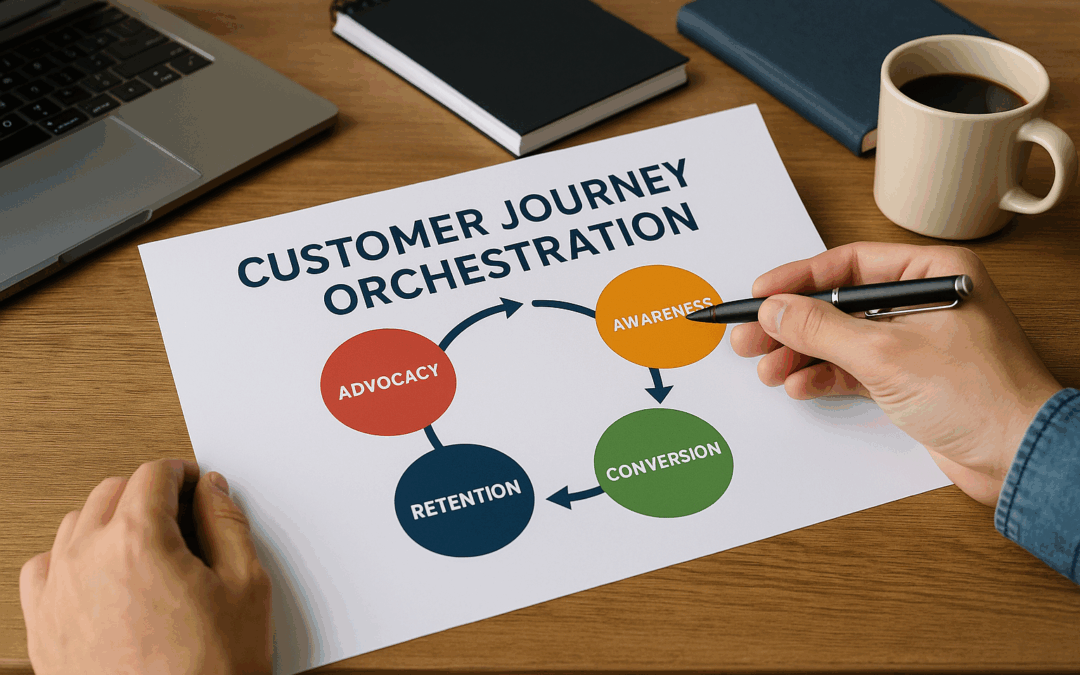
Customer journey orchestration (CJO) changes that. It’s the process of designing and synchronizing every touchpoint across the customer lifecycle to create a seamless, personalized experience. When done effectively, CJO transforms fragmented interactions into a cohesive journey that feels effortless to the customer and strategic for the brand.
What Is Customer Journey Orchestration
Customer journey orchestration goes beyond mapping out customer paths—it’s about managing them in real time. Traditional journey mapping visualizes what customers might do, while orchestration actively responds to what they are doing.
It integrates data, automation, and analytics to deliver the right message, on the right channel, at the right moment.
In simple terms, CJO connects every part of the customer experience—marketing, sales, service, and loyalty—so that no interaction feels disconnected or repetitive. The result is a brand experience that’s consistent, personalized, and continuous.
Why Customer Journey Orchestration Matters
Today’s customers expect more than convenience—they expect consistency. They move between devices, channels, and platforms seamlessly, and they expect brands to keep up.
Without orchestration, experiences become fragmented: marketing messages don’t match sales offers, and customer support might not know about previous interactions. This creates frustration and erodes trust.
Here’s why CJO has become essential for modern marketing:
- Personalization at scale: It uses data to deliver experiences tailored to individual preferences and behaviors.
- Real-time responsiveness: Brands can react instantly to customer signals, improving satisfaction and conversions.
- Cross-department alignment: Marketing, sales, and service teams work from a unified understanding of the customer.
- Higher retention and loyalty: Seamless experiences increase satisfaction and reduce friction.
In an omnichannel world, orchestration is the key to making personalization truly work.
The Key Components of Effective Journey Orchestration
To build a synchronized customer journey, brands must align three critical elements: data, technology, and strategy.
1. Unified Customer Data
A complete view of the customer is the foundation of orchestration. That means consolidating data from multiple sources—CRM, website analytics, email, social, and offline interactions—into a single profile.
Unified data helps identify where each customer is in their journey and what actions will move them forward. The more accurate the data, the more effective the orchestration.
2. Intelligent Automation
Automation tools power orchestration by managing repetitive processes and triggering real-time actions based on customer behavior. For example, if a user abandons a shopping cart, the system can automatically send a reminder email or personalized offer.
3. Journey Analytics
Analytics turn raw data into insight. Journey analytics track how customers interact across touchpoints, identifying pain points, opportunities, and drop-offs. These insights guide optimization and help refine messaging and timing.
4. Orchestration Platforms
Customer journey orchestration platforms—like Adobe Journey Optimizer, Salesforce Interaction Studio, or Iterable—integrate data and automation into one ecosystem. They enable marketers to design, execute, and monitor journeys in real time.
5. Human Oversight
While automation drives efficiency, human creativity and empathy remain essential. Marketers interpret insights, craft narratives, and ensure that automated experiences stay aligned with brand values.
Steps to Implement a Customer Journey Orchestration Strategy
Transitioning from fragmented marketing to orchestrated experiences requires structure and patience. Here’s how to approach it effectively.
Step 1: Map the Customer Lifecycle
Begin by defining your major journey stages—awareness, consideration, conversion, retention, and advocacy. Identify the goals, emotions, and pain points customers experience at each phase.
Step 2: Audit Existing Touchpoints
List all customer interactions across channels, from digital ads to post-purchase support. Look for inconsistencies, gaps, or duplicated messages that could confuse or frustrate users.
Step 3: Centralize Data Sources
Integrate customer data across departments. A unified data view ensures that everyone—from marketing to customer service—operates from the same understanding of the user.
Step 4: Segment and Personalize
Group customers by intent, behavior, or lifecycle stage rather than broad demographics. Then tailor messaging and offers for each segment using automation and predictive analytics.
Step 5: Automate Responsively
Set up automated workflows triggered by real-time actions. For example, if a user views a product multiple times but doesn’t purchase, send a dynamic email offering additional information or an incentive.
Step 6: Measure and Refine
Use journey analytics to track engagement, satisfaction, and conversion across touchpoints. Adjust messaging, timing, and channel mix based on insights. Orchestration is a continuous process of learning and improvement.
Common Challenges in Journey Orchestration
Implementing CJO isn’t without its hurdles. The most common challenges include:
- Data silos: Disconnected systems prevent a unified view of the customer.
- Complex tech stacks: Managing multiple platforms can create integration issues.
- Over-automation: Too many automated messages can feel impersonal or overwhelming.
- Lack of alignment: Teams often operate in isolation without shared goals or metrics.
Overcoming these challenges requires clear leadership, cross-functional collaboration, and ongoing refinement. The most successful brands build orchestration into their culture—not just their marketing technology.
Real-World Applications of Journey Orchestration
Customer journey orchestration can be applied across industries to deliver more relevant, seamless experiences.
- E-commerce: Automate abandoned cart recovery, product recommendations, and loyalty follow-ups.
- Finance: Coordinate onboarding, education, and retention communications for new clients.
- Healthcare: Streamline patient engagement with personalized appointment reminders and follow-ups.
- Education: Guide prospective students from inquiry to enrollment with contextual content.
- B2B Marketing: Align lead nurturing, sales outreach, and customer success into one integrated experience.
In each case, orchestration ensures that every step of the journey feels connected and meaningful.
The Future of Customer Experience Is Orchestrated
The future of marketing lies in connection—not just between brands and customers, but between every touchpoint that defines their relationship.
As technology advances, AI and predictive analytics will make journey orchestration even more precise, anticipating needs before customers express them. But the heart of orchestration will always be empathy—the ability to understand, anticipate, and respond with care.
When brands orchestrate journeys thoughtfully, they transform marketing into relationship-building. The result isn’t just higher engagement or conversion—it’s loyalty built on consistency, trust, and understanding.

by Research Team | Dec 1, 2025 | Customer Experience, Digital Marketing
In digital marketing, success often hinges on understanding what your customers truly want. Businesses spend millions on analytics tools, trend forecasts, and competitor research—yet one of the most powerful sources of insight is often overlooked: customer feedback.
Feedback isn’t just about satisfaction scores or post-purchase surveys. When gathered and used effectively, it becomes the foundation for data-driven campaigns that resonate with your audience, improve conversions, and strengthen brand loyalty.
Let us explore how to transform raw feedback into actionable strategies that elevate your marketing results.
Why Customer Feedback Matters
At its core, customer feedback bridges the gap between assumptions and reality. While analytics can tell you what happened, feedback explains why it happened.
- Identifies pain points – Customers highlight friction in your website, checkout process, or communication.
- Reveals opportunities – Suggestions can uncover new product features, services, or campaign angles.
- Builds trust – Actively listening and responding shows that you value your audience, boosting brand perception.
In short, feedback doesn’t just enhance your customer experience—it powers smarter campaigns that are more likely to succeed.
Step 1: Collect Feedback from Multiple Channels
Relying on a single source of feedback won’t give you the full picture. To make your campaigns truly data-driven, gather input from a variety of touchpoints:
- Surveys and polls
- Use short, targeted surveys post-purchase or post-interaction.
- Tools like Typeform or Google Forms help collect responses at scale.
- Social media listening
- Monitor mentions, comments, and reviews on platforms like Facebook, Instagram, and LinkedIn.
- Social listening tools such as Hootsuite or Brandwatch can track sentiment trends.
- Customer support logs
- Support tickets and chat logs often reveal recurring frustrations or questions.
- Tagging and categorizing these complaints creates a goldmine of insights.
- Website behavior analysis
- Use heatmaps and session recordings (Hotjar, Crazy Egg) to see where users get stuck.
- Combine this with exit surveys such as “What stopped you from completing your purchase?”
- Product reviews and testimonials
- Analyze what customers love or dislike about your product.
- Identify keywords and recurring themes to integrate into messaging.
By diversifying feedback channels, you reduce bias and gain a holistic view of your audience’s experience.
Step 2: Organize and Analyze the Data
Raw feedback can be overwhelming. To make it useful for campaigns, structure it into categories.
- Quantitative feedback (ratings, yes/no, multiple choice): Easy to chart and compare.
- Qualitative feedback (open comments, reviews): Richer insights but require text analysis.
Tools and Methods for Analysis
- Sentiment analysis – AI-powered tools can identify whether feedback is positive, neutral, or negative.
- Thematic grouping – Group similar comments under themes like pricing, navigation, or support.
- Frequency analysis – Track how often a particular pain point or compliment comes up.
When you start noticing patterns—like multiple customers asking for easier checkout or faster shipping—you’ve uncovered campaign opportunities.
Step 3: Translate Insights into Campaign Strategies
Here’s where feedback turns into fuel for digital marketing campaigns.
- Content marketing
- If feedback shows customers struggle with product setup, create how-to blogs, explainer videos, or email tutorials.
- Example: A software company launches a webinar series addressing the top five pain points mentioned in support tickets.
- Email marketing
- Use feedback to segment audiences. For example, customers who mention pricing concerns may receive value-focused campaigns.
- Include customer quotes in emails to strengthen social proof.
- Advertising campaigns
- Highlight solutions to pain points directly in ad copy.
- Example: If customers complain about slow delivery, run ads emphasizing “Fast, 2-Day Shipping Guaranteed.”
- Product development and promotions
- If reviews reveal customers love a specific feature, center future campaigns around it.
- Offer discounts or bundles that directly address customer suggestions.
By aligning campaigns with real customer concerns, your messaging feels less like marketing and more like a conversation.
Step 4: Close the Loop with Customers
Collecting and using feedback is only half the job. To maximize impact, let your customers know you’ve acted on their input.
- Share updates publicly – Announce product improvements or campaign changes that came directly from feedback.
- Personal follow-ups – Email customers who suggested changes to thank them and show the update.
- Highlight testimonials – Feature satisfied customers in campaigns to build community and credibility.
Closing the loop reinforces trust and encourages more people to share feedback in the future.
Step 5: Measure Campaign Success
Finally, track whether campaigns informed by feedback are moving the needle. Consider metrics such as:
- Engagement rates (higher when content addresses real concerns)
- Conversion rates (improved when campaigns align with customer priorities)
- Customer satisfaction or Net Promoter Score (NPS)
- Retention and repeat purchases
When you connect customer voices to measurable business outcomes, you prove the value of feedback-driven marketing.
Final Thoughts
Customer feedback isn’t just “nice to have”—it’s a strategic advantage. Brands that listen, analyze, and act on feedback build campaigns that feel relevant, human, and effective.
The next time you’re brainstorming your digital marketing strategy, don’t just rely on competitor benchmarks or industry reports. Tap into your audience’s voice. They’re already telling you what they want—your job is to transform those insights into smart, data-driven campaigns.

by Research Team | Dec 1, 2025 | Artificial Intelligence, Customer Experience, Marketing Technology, Personalization
Automation has changed marketing forever. Tasks that once took hours—sending emails, analyzing data, scheduling content—now happen in seconds. Yet with all this efficiency, something vital is at risk: the human connection that makes marketing meaningful.
Human-centered automation bridges that gap. It combines the speed and precision of technology with the empathy, creativity, and emotional intelligence only people can provide. The result is marketing that feels personal, not mechanical—powered by data, but guided by humanity.
What Is Human-Centered Automation
Human-centered automation is the strategic use of technology to enhance, not replace, human interaction in marketing. It means designing automated systems that reflect empathy, respect, and understanding—ensuring customers feel valued, not processed.
Instead of using automation solely for volume or speed, brands apply it to improve relevance, timing, and personalization. This balance creates marketing that’s both efficient and emotionally resonant.
At its core, human-centered automation asks one key question: Does this automation make the customer’s experience better?
If the answer is yes, it’s aligned with true marketing purpose.
The Importance of Human Touch in Automated Marketing
Automation has undeniable benefits—cost savings, scale, and consistency. But overreliance can make communication cold and generic. Audiences today can sense when messages are mass-produced or impersonal, and they respond accordingly.
The human element is what builds trust. People don’t connect with algorithms; they connect with empathy, storytelling, and authenticity. When brands use automation responsibly, they enhance those human traits instead of erasing them.
Here’s why human-centered automation matters:
- It builds trust through authenticity. Personalized interactions show that a brand understands and respects its audience.
- It enhances efficiency without losing empathy. Smart automation saves time while keeping communication warm and relevant.
- It supports long-term loyalty. Customers are more likely to stay engaged with brands that treat them as individuals, not data points.
Human-centered automation transforms technology from a shortcut into a tool for deeper connection.
Principles of Human-Centered Automation
Balancing technology and empathy requires a thoughtful approach. These guiding principles ensure automation remains human-first.
1. Purpose Before Process
Every automated system should begin with a clear human purpose. Ask: what problem does this solve for the customer? Automation that benefits only the brand (like sending constant reminders) may create short-term engagement but long-term fatigue.
2. Personalization Without Intrusion
Use data to personalize experiences responsibly. Relevant recommendations and reminders are helpful; over-targeting or over-communicating feels invasive. Transparency about how data is used builds comfort and confidence.
3. Empathy in Design
Automated messages should reflect empathy in tone, timing, and context. A well-crafted “thank you” email or birthday message can feel just as genuine as one written by hand—if it’s thoughtfully designed.
4. Contextual Awareness
Timing matters as much as content. Sending an automated message at the wrong moment—such as promoting a product immediately after a complaint—is a sign of poor orchestration. Human-centered systems respond to context, not just triggers.
5. Collaboration Between Humans and AI
Automation should assist marketers, not replace them. While machines handle data processing, humans oversee strategy, storytelling, and emotion. The best results come from synergy, not substitution.
Real-World Applications of Human-Centered Automation
Human-centered automation isn’t theoretical—it’s already reshaping digital marketing across industries.
Personalized Email Journeys
AI-driven platforms can analyze behavior to send tailored messages, but the tone and narrative are still crafted by human marketers. This ensures each email feels like a conversation, not a command.
Smart Customer Support
Chatbots provide instant help for common issues, while human agents step in for complex or emotional situations. This blend offers efficiency and compassion.
Predictive Personalization
Predictive tools anticipate what customers need next, such as recommending products or content. Human review ensures these predictions align with brand values and customer sensitivity.
Social Media Automation
Scheduling tools free marketers from repetitive posting, allowing them to focus on real-time engagement, listening, and community building—the human side of social connection.
Voice and Conversational AI
As voice assistants grow, tone, pacing, and phrasing matter more than ever. Brands that humanize these experiences—through warmth and clarity—stand out.
Challenges in Keeping Automation Human
While automation offers immense potential, maintaining authenticity isn’t always easy. Common challenges include:
- Over-Automation: Excessive reliance on automated messages can make brands sound robotic or repetitive.
- Data Misinterpretation: Algorithms can misread context or emotion, leading to tone-deaf responses.
- Privacy Concerns: Personalization requires data, but mishandling it undermines trust.
- Loss of Creativity: Automation can encourage “set and forget” habits, stifling innovation and storytelling.
Solving these challenges means blending technology with human oversight. Automation should amplify creativity, not suppress it.
Best Practices for Human-Centered Marketing Automation
Design With Empathy
Write automated messages as if you’re speaking to one person, not thousands. Use natural language, avoid excessive jargon, and respect user preferences.
Set Boundaries
Automation should enhance—not dominate—the customer journey. Review automated workflows regularly to ensure they still serve the customer’s best interests.
Keep Humans in the Loop
Every automated system needs human supervision. Marketers should review message timing, sentiment, and performance to ensure ongoing relevance.
Test and Learn
A/B testing helps find the balance between efficiency and warmth. Track open rates, click-throughs, and sentiment to see how audiences respond to tone and timing.
Use Data Transparently
Explain how and why customer data is used. Offering control over frequency or content preferences demonstrates respect and builds trust.
The Future of Automation Is Human
As AI and machine learning continue to evolve, automation will become even more sophisticated. But the brands that succeed won’t be the ones that automate the most—they’ll be the ones that automate the best.
Human-centered automation isn’t about replacing people; it’s about freeing them to focus on what technology can’t replicate: creativity, emotion, and connection.
In the end, marketing is still a human conversation—just one enhanced by smarter tools. The goal isn’t to sound automated, but to sound like you care.
When automation works in harmony with empathy, brands don’t just save time—they build relationships that last.

by Research Team | Nov 13, 2025 | Customer Experience, Marketing Strategy
Many marketing strategies focus heavily on acquisition, yet long-term growth depends on what happens after the first conversion. Retention marketing addresses this gap by prioritizing customer relationships, ongoing value, and repeat engagement.
For service-based and digital-first brands, retaining existing customers is often more cost-effective than acquiring new ones. Strong retention strategies reduce churn, increase lifetime value, and create more predictable revenue over time.
This draft explores how retention marketing works, why it matters, and which strategies consistently improve performance.
What Retention Marketing Really Is
Retention marketing focuses on keeping customers engaged, satisfied, and loyal after their initial conversion. It emphasizes relationship-building rather than transactional interactions.
Key objectives include:
- Encouraging repeat purchases or renewals
- Increasing usage and engagement
- Strengthening trust and brand affinity
- Reducing churn and dissatisfaction
Retention marketing is not a single tactic. It is an ongoing strategy that spans communication, experience, and value delivery.
Why Retention Matters More Than Ever
Customer expectations are higher than ever. With more options available, switching costs are low and loyalty must be earned continuously.
Retention-focused marketing delivers several advantages:
- Higher lifetime value per customer
- Lower acquisition dependency
- Increased referral and advocacy potential
- More stable revenue forecasting
Brands that neglect retention often see strong top-line growth paired with weak long-term performance.
Understand the Drivers of Churn
Effective retention starts with understanding why customers leave.
Common churn drivers include:
- Poor onboarding experiences
- Lack of perceived value over time
- Misaligned expectations
- Inconsistent communication
- Limited personalization
Use surveys, support data, usage analytics, and feedback loops to identify patterns. Churn is rarely random and often signals experience gaps.
Build Strong Onboarding Experiences
The early stages of the customer relationship are critical. Onboarding sets expectations and establishes perceived value.
Strong onboarding includes:
- Clear guidance on next steps
- Education that aligns with customer goals
- Timely support and check-ins
- Early wins that reinforce value
Retention efforts are far more effective when customers understand how to succeed from the start.
Personalize Communication Across the Lifecycle
Generic messaging weakens engagement. Retention marketing relies on relevance and timing.
Personalization can include:
- Behavior-based email campaigns
- Usage-driven recommendations
- Milestone and progress recognition
- Segmented messaging by lifecycle stage
Personalization signals attentiveness and reinforces the feeling that the brand understands customer needs.
Create Ongoing Value Beyond the Core Offer
Retention improves when customers receive consistent value beyond the initial product or service.
Value-add strategies include:
- Educational content and resources
- Exclusive insights or access
- Community engagement opportunities
- Proactive support and guidance
When customers feel supported and informed, loyalty increases naturally.
Use Feedback to Strengthen Relationships
Retention marketing is a two-way conversation.
Actively seek feedback through:
- Customer surveys
- Net promoter score tracking
- Support interactions
- One-on-one check-ins for high-value clients
More importantly, act on that feedback. Closing the loop builds trust and shows commitment to improvement.
Align Retention Efforts With Customer Success
Retention marketing works best when aligned with customer success initiatives.
Collaboration between marketing, support, and account teams ensures:
- Consistent messaging
- Shared understanding of customer health
- Faster response to risk signals
- Better upsell and cross-sell timing
Retention is strongest when customers feel supported across every touchpoint.
Measure the Right Retention Metrics
Retention success should be measured beyond surface-level engagement.
Key metrics include:
- Churn rate
- Customer lifetime value
- Repeat purchase or renewal rates
- Product or service usage trends
- Customer satisfaction indicators
Tracking these metrics helps identify opportunities for improvement and validate strategy effectiveness.
Avoid Common Retention Pitfalls
Retention strategies often fail due to avoidable mistakes.
Common pitfalls include:
- Over-communicating without adding value
- Ignoring disengaged customers until it is too late
- Treating retention as a reactive effort
- Focusing solely on discounts to retain customers
Sustainable retention is built on value, not incentives alone.
Scaling Retention Marketing Thoughtfully
As brands grow, retention strategies must scale without losing personalization.
Scalable approaches include:
- Automated lifecycle campaigns
- Predictive churn modeling
- Tiered engagement strategies
- Clear ownership of retention initiatives
Balance automation with human touchpoints to maintain authenticity.
Long-Term Perspective
Retention marketing is not about preventing exits at all costs. It is about creating experiences that customers want to continue.
Brands that invest in retention build stronger relationships, more resilient revenue, and greater long-term impact. When customers feel valued beyond the initial sale, loyalty becomes a natural outcome rather than a forced objective.

by Research Team | Oct 27, 2025 | Artificial Intelligence, Automation, Customer Experience
When most marketers think of automation, email campaigns often come to mind first. But today, marketing automation powered by AI has evolved far beyond inboxes and autoresponders. From intelligent chatbots to dynamic ad targeting and real-time SMS workflows, automation now reaches across nearly every digital channel—and it’s changing how brands engage customers at scale.
As customer expectations rise and personalization becomes the norm, brands that leverage automation across their ecosystem are better positioned to deliver timely, relevant, and consistent experiences.
The Evolution of Marketing Automation
Early marketing automation tools focused almost entirely on email—automating welcome sequences, drip campaigns, and cart recovery messages. These tools helped marketers nurture leads without constant manual intervention.
Today, automation capabilities extend across an entire customer journey and span channels such as:
- SMS and push notifications
- Chatbots and live chat platforms
- Website personalization
- Programmatic advertising
- CRM and sales automation
- Social media direct messaging
AI and machine learning now enable marketers to analyze behaviors, predict intent, and deliver tailored content, not just reactively, but proactively.
Why Automation Beyond Email Matters
1. Omnichannel Customer Expectations
Consumers no longer engage with brands on a single channel. They browse on mobile, follow on Instagram, chat via Messenger, and return later via desktop. Relying solely on email limits your ability to meet them where they are, when it matters most.
2. Speed and Responsiveness
AI-powered automation lets you respond in real time. Whether it’s an SMS triggered by cart abandonment or a chatbot that handles product inquiries instantly, faster responses increase conversions and customer satisfaction.
3. Scalability Without Burnout
As your customer base grows, maintaining 1:1 interactions manually becomes impossible. Automation enables scalable personalization—delivering meaningful touchpoints across thousands of users without sacrificing quality.
4. Behavior-Based Journeys
AI tools analyze real-time user behavior—like time on page, click patterns, and engagement history—to trigger tailored workflows. The result is a more dynamic and responsive user journey.
Key Channels Where AI-Powered Automation Thrives
SMS and Push Notifications
SMS automation allows marketers to send personalized messages at key moments, like restocking reminders, appointment alerts, or shipping updates. When combined with AI, these messages can be optimized for timing and relevance.
Example: A customer browses shoes but doesn’t buy. A few hours later, they receive a limited-time SMS discount for that exact item.
Chatbots and Conversational AI
Intelligent chatbots on websites or messaging platforms can answer questions, qualify leads, recommend products, and even assist with checkout. AI makes these bots feel more human, adapting to user tone and intent.
Example: A user lands on your site and asks about a product. The chatbot answers, suggests a related item, and offers a coupon—all before the visitor leaves.
Dynamic Content and Website Personalization
AI can analyze user data—like geographic location, behavior, or past purchases—to customize what content appears on your website. Landing pages can adapt based on visitor profiles to improve relevance and conversions.
Example: A repeat visitor sees different homepage banners than a first-time visitor. Product recommendations are based on their past shopping behavior.
Social Media and Direct Messaging
AI can monitor engagement on social platforms and trigger automated DMs to followers who comment, engage, or express interest in offers. Some strategies also sequence content based on past behavior to deepen engagement.
Example: A customer clicks on a carousel ad. Days later, they receive a follow-up promo message based on their interaction history.
CRM and Sales Automation
Modern marketing automation integrates with sales pipelines to score leads, automate follow-ups, and deliver personalized outreach based on intent. This improves alignment between marketing and sales while speeding up conversions.
Example: A lead downloads a case study, visits the pricing page twice, and replies to a chatbot. AI flags them as high-intent and auto-schedules a rep follow-up.
Enabling Automation: What You Need to Make It Work
Successfully implementing cross-channel automation doesn’t require the flashiest tools—it requires a clear strategy, thoughtful workflows, and the ability to unify your customer data across touchpoints. Before expanding your automation efforts, consider these foundational components:
1. Centralized Customer Data
To create seamless experiences across channels, your systems need to “talk” to each other. A centralized customer data framework helps ensure that your automation is based on accurate, up-to-date behavioral and demographic insights.
2. Clearly Defined Goals and Triggers
Every automation workflow should begin with a clear purpose. Whether you’re aiming to reduce cart abandonment, onboard new users, or re-engage inactive leads, define both the desired outcome and the behavioral trigger that will initiate the sequence.
3. Flexible Workflow Design
Effective automation strategies often follow branching logic, delivering different messages or actions based on customer responses or engagement. This flexibility ensures the experience remains relevant and timely for each user.
4. Consistent Messaging Across Channels
While automation allows you to engage users on various platforms, consistency in tone, branding, and value proposition is key. Each channel should support a unified story, even if it’s tailored to the medium.
5. Ongoing Monitoring and Refinement
Automation is not a set-it-and-forget-it strategy. Successful brands regularly test variations, review performance metrics, and make data-driven adjustments to improve outcomes over time.
Beyond the Inbox: The Future Is Integrated
Email is still powerful, but it’s just one thread in a much larger marketing web. Today’s consumers expect relevance, speed, and personalization—on the platform of their choice, at the time of their choosing.
By moving beyond email and embracing automation across SMS, web, chat, and social, marketers can create cohesive, data-driven experiences that meet users where they are. With AI as a backbone, these experiences feel timely, helpful, and—most importantly—human.
Brands that adopt a channel-agnostic, customer-centric approach to automation aren’t just keeping up with digital trends—they’re redefining what marketing can be.

by Research Team | Oct 24, 2025 | Brand Loyalty, Brand Strategy, Customer Engagement, Customer Experience, Customer Journey, Customer Loyalty
Marketing today is no longer just about acquiring customers—it’s about building relationships that inspire loyalty, trust, and advocacy. A well-designed customer journey doesn’t stop at conversion; it continues beyond the sale, transforming satisfied buyers into passionate brand ambassadors.
This shift from awareness to advocacy represents the future of sustainable growth. When customers believe in a brand enough to share it with others, marketing evolves from a transaction into a community-driven movement.
Understanding the Modern Customer Journey
The customer journey isn’t a straight line from awareness to purchase—it’s a dynamic cycle shaped by experience, emotion, and engagement.
Traditionally, marketers focused on the funnel: awareness, consideration, and conversion. But today’s customer expects more. They want meaningful experiences at every stage, ongoing communication, and a sense of connection to the brand.
The modern customer journey includes five key stages:
- Awareness: The customer discovers your brand for the first time.
- Consideration: They explore whether your solution fits their needs.
- Conversion: They make a purchase or take action.
- Retention: They stay engaged and satisfied with post-purchase support.
- Advocacy: They actively recommend your brand to others.
The goal isn’t just to guide customers through these stages—but to delight them so thoroughly that they become advocates who extend your reach organically.
Why Advocacy Matters More Than Ever
In an age of skepticism and information overload, trust has become a brand’s most valuable asset. Studies show that people trust recommendations from peers far more than advertisements.
When customers advocate for your brand, they do what no campaign can—they lend credibility. Advocacy amplifies your message with authenticity and emotion.
Here’s why customer advocacy is a powerful growth driver:
- Authentic influence: Word-of-mouth referrals carry more weight than any paid ad.
- Cost efficiency: Loyal advocates generate organic growth, reducing acquisition costs.
- Community building: Advocacy fosters a shared sense of purpose and belonging.
- Sustainable differentiation: Competitors can copy your products, but not your relationships.
When customers become champions, they do more than buy—they build your brand with you.
The Key Elements of a Journey That Builds Advocacy
Designing a journey that leads to advocacy requires intention and empathy. Every interaction must deliver value and foster trust.
1. Purpose and Storytelling
Customers don’t connect to products—they connect to stories and purpose. Communicate your brand’s mission clearly and consistently across all channels. When customers understand why you exist, they feel part of something larger than a transaction.
2. Experience Over Promotion
Each stage of the journey should focus on experience, not just persuasion. From a seamless website to responsive support, every touchpoint should reinforce your brand’s promise and personality.
3. Personalization and Relevance
Use data and insights to tailor experiences to individual preferences. Personalization shows customers they’re seen and valued, strengthening emotional connection and engagement.
4. Consistency Across Channels
Whether online, in-store, or on social media, your message and tone should feel unified. Consistency creates reliability—an essential ingredient in trust.
5. Empowerment
Empower your customers with knowledge, tools, and confidence. Tutorials, guides, or user-generated content programs help them feel capable and connected to your brand mission.
Turning Customers into Advocates
While loyalty can be earned through quality and service, advocacy requires inspiration. Customers become advocates when they feel emotionally invested and personally proud to associate with your brand.
Here’s how to nurture that transformation:
Deliver Exceptional Value
Advocacy begins with satisfaction. Deliver products and services that not only meet expectations but exceed them. When customers are delighted, they naturally want to share that experience.
Encourage Feedback and Listen
Invite feedback at every stage of the journey. Responding to reviews and incorporating customer suggestions demonstrates respect and responsiveness—qualities that build loyalty and advocacy alike.
Create Emotional Connection
Emotional resonance drives advocacy more than rational satisfaction. Share human stories, celebrate customer milestones, and communicate with warmth. People advocate for brands that make them feel something.
Build a Community
A brand community provides a shared space for connection, storytelling, and belonging. Whether through social groups, events, or online forums, communities strengthen the bond between customers and your brand.
Reward and Recognize Advocates
Publicly acknowledging and rewarding advocates—through loyalty programs, ambassador roles, or early access—reinforces positive behavior. Recognition turns engagement into enthusiasm.
Measuring the Impact of Advocacy
Advocacy can be measured both qualitatively and quantitatively. Beyond traditional marketing metrics, consider these indicators of advocacy success:
- Referral rate: The percentage of new customers acquired through recommendations.
- Social engagement: Mentions, shares, and user-generated content that reflect organic enthusiasm.
- Customer lifetime value (CLV): Advocates tend to spend more and stay longer.
- Net Promoter Score (NPS): A key measure of customer willingness to recommend your brand.
- Community growth: Increased participation and retention within brand communities.
The most telling metric, however, is sentiment—how customers talk about your brand when you’re not in the room.
Real-World Approaches to Customer Advocacy
Across industries, brands are finding creative ways to turn customers into ambassadors.
Some focus on exclusive experiences—inviting loyal customers to product previews or behind-the-scenes sessions. Others empower users to share stories, reviews, and creative content that humanize the brand.
Educational content also plays a role. When brands help customers succeed—through tutorials, webinars, or value-driven resources—they become trusted partners, not just vendors.
The underlying principle is the same: advocacy grows from authentic relationships, not incentives alone.
The Human Element in Every Journey
Automation and AI have made it easier to manage complex customer journeys, but technology can’t replace empathy. Every data point represents a person with expectations, challenges, and emotions.
The most successful brands design journeys that balance precision with personality. They use technology to anticipate needs—and human creativity to connect meaningfully.
When customers feel understood, valued, and empowered, they evolve from buyers into believers.
From Transactions to Tribes
The path from awareness to advocacy isn’t linear—it’s a cycle. Every advocate you create can inspire new awareness, restarting the journey for others.
In the end, advocacy isn’t the last stage of marketing—it’s the most powerful form of it. It turns customers into collaborators, stories into movements, and brands into communities.
The brands that understand this truth won’t just win attention; they’ll earn devotion.