
by Research Team | Nov 25, 2025 | Compliance, Content Marketing, Gamification Marketing
Industrial companies face challenges that many other sectors never experience. Workers operate in high risk environments. Safety procedures must be followed without exception. Training is ongoing and essential. Compliance requirements are strict and constantly evolving. In these conditions, keeping employees engaged can be difficult. Traditional training methods often struggle to hold attention, especially when workers are busy, tired, or managing physically demanding tasks. This is where gamification becomes a valuable strategy for industrial marketers and training teams.
Gamification uses game inspired elements to make learning, training, and engagement more enjoyable and interactive. When applied correctly, it helps companies strengthen safety cultures, improve knowledge retention, and encourage long term compliance. For organizations that want to modernize their approach, gamification offers a practical path that aligns with real world needs.
Why Gamification Matters in Industrial Environments
At first glance, gamification may seem like a strategy more suited to consumer apps or education platforms. In reality, it fits naturally into industrial settings because workers benefit from training that is clear, hands on, and rewarding. High risk industries depend on skilled workers who understand and follow procedures accurately. Making training more engaging helps companies reinforce these skills.
Several factors make gamification especially effective for industrial teams.
Workers respond well to interactive learning
Many industrial roles rely on practical, hands on tasks. Workers often prefer learning by doing rather than reading long manuals. Gamified learning uses quizzes, challenges, and interactive modules that match this preference.
Training must be updated frequently
Safety protocols and compliance standards change. Gamified platforms make it easier to deliver ongoing updates without overwhelming workers. New modules can be added in short, digestible formats.
Companies need to track retention and performance
Gamified systems generate data that reveals how well workers understand the material. This information helps training teams identify gaps before they become safety risks.
Motivation improves when progress is measurable
Recognition tools such as badges, points, and achievement levels give workers a sense of accomplishment. This motivates them to complete training with attention and effort.
How Gamification Supports Compliance and Safety
Compliance requires more than telling workers what to do. It requires consistent behavior and understanding. Gamification supports this in several ways.
It makes complex information easier to understand
Safety training often includes technical language, regulations, and detailed procedures. Gamified modules simplify the material by breaking it into smaller steps and using interactive visuals or scenario based choices.
It reinforces repetition without fatigue
Repetition strengthens memory. However, traditional repetition can feel boring. Gamified repetition keeps workers engaged by rewarding accuracy and improvement.
It encourages safe habits through simulated practice
Simulated challenges allow workers to make decisions in a controlled environment. These simulations help them understand potential hazards and the correct responses without facing real world danger.
It supports training in short sessions
Industrial shifts can be long and demanding. Gamified training can be completed in short intervals without losing progress. This flexibility benefits both workers and supervisors.
Ways Industrial Marketers Can Use Gamification
While gamification is commonly associated with internal training, it also plays an important role in marketing. Industrial buyers want to see the value of products clearly. Gamified content can help companies explain complex features, highlight safety benefits, and support decision making.
Here are several effective applications.
Interactive product demonstrations
Gamified demos allow buyers to click through features, explore product scenarios, and understand how equipment performs under specific conditions. This builds clarity and confidence.
Digital safety assessments
Industrial marketers can offer free assessments that score users on their safety practices. At the end, the assessment recommends products that solve the user’s challenges. This is both helpful and educational.
Compliance readiness quizzes
Short, gamified quizzes help companies identify whether their teams are ready to meet new regulations. These assessments position the brand as a knowledgeable partner and generate qualified leads.
Educational campaigns with rewards
Marketers can create campaigns that reward buyers for learning about new products or technologies. This may include completing modules, downloading guides, or participating in training challenges.
Building a Successful Gamification Strategy
Gamification only works when it is planned carefully. Industrial companies must consider the needs of workers, the structure of their training programs, and the goals of their marketing strategies.
The following steps will help guide an effective approach.
Start with clear objectives
Decide whether the goal is to improve safety training, increase compliance, explain product features, or generate new leads. The objective shapes every part of the gamification plan.
Keep the experience simple and focused
Gamification should make learning easier, not more complicated. Avoid unnecessary steps and ensure the design is intuitive for users at every skill level.
Use realistic scenarios
Industrial workers relate more to real world situations than abstract concepts. Authentic scenarios improve decision making and retention.
Provide immediate feedback
Gamified systems work best when users receive feedback as soon as they complete a challenge or answer a question. This helps reinforce correct behavior.
Reward progress and improvement
Badges, certificates, or performance levels give workers a sense of accomplishment. The goal is not to compete but to recognize growth.
Review performance data regularly
The data generated through gamified training can reveal common mistakes or areas where workers need additional support. This information strengthens future training programs.
The Future of Gamification in Industrial Sectors
As digital tools become more accessible, industrial companies are beginning to adopt new training and marketing methods. Gamification will continue to grow because it aligns with the needs of modern workforces. It creates an environment where learning feels practical, engaging, and relevant. It reduces the frustration associated with long training sessions and improves the accuracy of safety practices.
Gamification is more than a trend. It is a strategic approach that helps industrial companies support their workers, improve compliance, and communicate value more effectively.

by Research Team | Nov 25, 2025 | Content Marketing, Optimization, SEO
Ranking high on Google is no longer just about finding the right keywords—it’s about understanding the why behind the search. This is where search intent optimization comes in.
Search engines like Google are increasingly focused on delivering results that align with a user’s underlying motivation. So when someone types a query, the goal isn’t just to match the words—they want the right kind of answer. Marketers who align their content with search intent not only rank better but also convert more.
What Is Search Intent?
Search intent—also known as user intent—is the reason behind a user’s query. It’s the goal they hope to achieve when they type something into a search engine.
Search intent generally falls into four core categories:
1. Informational Intent
The user wants to learn something. These searches often start with:
- “How to…”
- “What is…”
- “Why does…”
- “Guide to…”
Example: “How does content atomization work?”
2. Navigational Intent
The user is trying to find a specific website or brand.
- “Facebook login”
- “Shopify help center”
- “Neil Patel blog”
Example: “Ahrefs keyword tool”
3. Transactional Intent
The user is ready to take action—usually a purchase, signup, or download.
- “Buy an ergonomic desk chair.”
- “Subscribe to Canva Pro”
- “Book a haircut near me”
4. Commercial Investigation
The user is comparing options before making a decision.
- “Best CRMs for small business”
- “iPhone vs. Samsung camera”
- “Webflow reviews 2025”
Understanding these categories helps shape your content to match the user’s mindset—not just their words.
Why Search Intent Matters for SEO and Conversions
1. Google Prioritizes Relevance
Google’s algorithms are increasingly designed to understand context. Even if your page is perfectly optimized for a keyword, it won’t rank if it doesn’t meet the searcher’s intent.
2. Reduces Bounce Rates
If your page matches what the user is looking for, they’ll stay longer. If it doesn’t, they’ll click away—and that signals poor relevance.
3. Improves Conversion Rates
When you speak with the right intent, your content moves users along the funnel naturally—from awareness to action.
4. Strengthens Content Strategy
Search intent helps guide what type of content to create for each stage of the buyer journey—from top-of-funnel education to bottom-of-funnel product pages.
How to Identify Search Intent
1. Look at the SERP (Search Engine Results Page)
Google often tells you exactly what users want. Type the query into the search and study the top-ranking results:
- Are they blogs, product pages, or videos?
- Are there featured snippets or “People also ask” boxes?
- Is Google showing local map results or shopping ads?
This will reveal whether Google sees the query as informational, transactional, or otherwise.
2. Pay Attention to the Language Used
Words like “buy,” “best,” “vs,” or “how to” are strong indicators of intent.
3. Use Keyword Tools
Some SEO tools now provide insight into search intent classifications and related long-tail variations.
How to Optimize for Different Types of Intent
Informational
- Create blog posts, how-to guides, and explainer videos
- Use headings and bullet points for easy scanning
- Provide actionable steps or answers early in the content
- Add internal links to deeper or related content
Example: A blog titled “How to Improve Website Accessibility” with subheadings, visuals, and a downloadable checklist.
Navigational
- Ensure your brand’s site is well-optimized and easy to find
- Use clear meta titles and brand signals
- Create dedicated landing pages for branded queries
Example: A landing page for “Zoom pricing plans” is clearly labeled and structured.
Transactional
- Optimize product or service pages with clear CTAs
- Include trust signals (reviews, badges, policies)
- Offer limited-time discounts or incentives
- Make navigation and checkout seamless
Example: A landing page for a subscription product with testimonials, FAQs, and a risk-free guarantee.
Commercial Investigation
- Write comparison posts or buyer guides
- Include product tables, pros and cons, and feature breakdowns
- Use schema markup for star ratings and rich snippets
- Keep content unbiased and focused on helping, not pushing
Example: “Top 5 Email Marketing Tools for 2025 Compared” with screenshots and use-case highlights.
Best Practices for Search Intent Optimization
1. Map Keywords to Intent in Your Strategy
Create a simple spreadsheet that assigns each target keyword to one of the four intent categories. This ensures content aligns with user needs from the start.
2. Re-optimize Existing Content
Audit your top pages. If a blog is ranking for a transactional query, consider turning it into a product page or linking it to one.
3. Use Clear CTAs Based on Intent
For informational content, guide users to more learning. For commercial content, present decision-making tools or demos.
4. Don’t Mix Intents on One Page
Each piece of content should focus on one primary intent. Mixing “learn more” with “buy now” can confuse users and hurt conversions.
Matching Content to Motivation
Search intent optimization is more than an SEO tactic—it’s a way to create truly helpful content that respects where users are in their journey.
By mapping intent, adjusting your format, and delivering the right experience at the right time, you don’t just improve rankings—you build trust, improve conversions, and create a better overall brand experience.

by Research Team | Nov 23, 2025 | Content Marketing, Multi Channel Marketing
Modern audiences consume information in different ways, across different devices, and through different formats. Some prefer short videos, others want long form articles, and many choose podcasts or quick social content. Because attention spans vary and user expectations shift from one platform to another, a single content format is no longer enough. Brands that want to stay relevant must build content journeys that meet users wherever they are and however they prefer to learn.
A multi-format content journey is a structured approach that delivers messages through various formats while maintaining consistent messaging. When done well, it supports stronger engagement, better reach, and a smoother path from discovery to conversion. This article explores how multi-format content journeys work, why they matter, and how brands can create them effectively.
Why Multi-Format Content Matters Today
People move between platforms throughout the day. They may start with a quick scroll on social media, continue researching on a laptop, then listen to a podcast while driving. A single format cannot serve every stage of this journey. Multi-format content supports the different needs and behaviors of each moment.
Several trends make this approach especially important.
Consumption habits have diversified
Some users want fast content like reels and shorts. Others want in depth guides they can save for later. Multi-format content ensures no audience segment is left out.
Algorithm behavior differs by platform
Each platform rewards different types of content. Short form video performs well on social media. Long form content performs well on blogs. Multi-format strategies maximize exposure.
User preferences shift based on context
People read, watch, and listen depending on mood, time, and device. Content journeys should accommodate these shifts.
Brands need consistent messaging across channels
Multi-format content helps maintain clarity even when the message appears in different styles.
By meeting users where they are, brands reduce friction and create a more intuitive experience.
How a Multi-Format Content Journey Works
Multi-format journeys involve mapping content to stages of the customer experience. Each format serves a specific role and guides the user forward.
Awareness stage
Users need quick, engaging content to introduce the topic. Effective formats include:
- Short videos
- Carousels
- Infographics
- Social posts
- Quick tips
These formats help users discover new ideas or understand a problem.
Consideration stage
Users want more detail and more value. Effective formats include:
- Blog posts
- Long form videos
- Guides
- Webinars
- Case studies
These pieces help users evaluate solutions.
Decision stage
Users need clarity and confidence. Effective formats include:
- Product pages
- Demos
- FAQs
- Comparison sheets
- Testimonials
Multi-format content supports each stage and leads users to the next step.
Key Content Formats to Include in a Journey
A strong content journey uses a combination of formats that complement each other. Below are common formats and how they contribute to the overall experience.
Blog articles
Blogs provide depth and context. They help users understand ideas fully and support SEO performance.
Short form video
Short videos capture quick attention and introduce key ideas in a simple way. They perform well on platforms like TikTok, Instagram, and YouTube Shorts.
Long form video
Tutorials, interviews, and walkthroughs help users learn in a visual, step by step format.
Podcasts
Podcasts allow users to consume content passively. They are ideal for storytelling, education, and expert discussions.
Infographics
Infographics simplify complex ideas into visual summaries. They improve comprehension and are easy to share.
Interactive content
Quizzes, checklists, and calculators help users participate actively and get personalized insights.
Downloadable guides
Ebooks, templates, and worksheets provide high value content that users can save and revisit.
Email sequences
Email content guides users through the journey in a structured, personalized way.
A balanced journey uses several of these formats without overwhelming the audience.
How to Build a Multi-Format Content Journey
Creating a multi-format strategy requires planning, collaboration, and a clear understanding of audience behavior. The steps below form a strong foundation.
Step 1: Identify the core message
Every format should communicate the same core idea. Consistency ensures users understand the message regardless of platform.
Step 2: Map the customer journey
Outline the stages your audience moves through. Determine what they need at each stage and which formats will support those needs.
Step 3: Repurpose content strategically
Instead of creating every asset from scratch, repurpose content across formats. For example:
- Turn a blog post into a series of short videos
- Extract infographics from a long guide
- Convert a webinar into a podcast episode
- Transform a case study into social posts
Repurposing maintains consistency and saves time.
Step 4: Match format to platform
Each platform favors specific types of content. Choose formats that align with platform strengths rather than forcing a single format everywhere.
Step 5: Keep design consistent
Visual consistency creates familiarity. Use the same color palette, typography, and tone across formats.
Step 6: Integrate calls to action
Each piece of content should guide users to the next step in the journey. Clear calls to action help maintain momentum.
Step 7: Track performance across formats
Monitor engagement, retention, and conversion metrics. Identify which formats perform best at each stage and refine the strategy accordingly.
Benefits of a Multi-Format Content Journey
When implemented correctly, multi-format strategies deliver long term advantages for both engagement and growth.
Higher reach
Different formats appeal to different audiences. Multi-format content expands visibility.
Better retention
Users are more likely to stay engaged when content meets their preferences.
Stronger brand identity
Consistent messaging across formats reinforces the brand’s voice and values.
Improved user experience
Users can choose how they want to consume the content, reducing friction.
More conversion opportunities
Multiple touchpoints increase the chance of conversion across channels.
The Future of Multi-Format Marketing
As digital platforms continue to evolve, brands must remain adaptable. New content formats will emerge and user behavior will continue to shift. Multi-format content journeys create a foundation for flexibility. They allow brands to engage audiences wherever they are today while maintaining room to grow tomorrow.
Brands that embrace multi-format strategies will continue to thrive in environments where attention, preference, and technology change quickly. Meeting users where they are is no longer optional. It is the key to building strong, long lasting connections.

by Research Team | Nov 21, 2025 | Content Marketing, Organic Marketing
Paid advertising plays a valuable role in digital marketing, but it is not the only way to generate conversions. Brands that rely solely on paid channels often face rising costs, shrinking attention spans, and unpredictable algorithm changes. Building an organic content funnel offers a sustainable, long term solution that consistently attracts, nurtures, and converts audiences without the need for ongoing ad spend.
An organic content funnel is a structured path that guides users from initial discovery to final conversion using high quality content. Each stage delivers value, builds trust, and encourages the next step. This approach helps brands grow their audience, increase engagement, and drive conversions even with limited budgets.
This article explains how to build a high-converting content funnel entirely through organic marketing.
Why Organic Content Funnels Work
Organic funnels rely on strategic content rather than paid distribution. They are built to serve user needs, build credibility, and create momentum. Several advantages make organic funnels a powerful tool for modern marketers.
They attract qualified audiences
Organic content draws people who are already interested in the topic. These users enter the funnel with higher intent and stronger motivation.
They build trust naturally
Content that educates, informs, and guides helps users see the brand as a reliable resource. Trust leads directly to conversions.
They perform long term
Unlike ads, organic content continues to drive visibility for months or years with proper maintenance.
They support all stages of the buyer journey
Well designed content funnels lead users from awareness to action without feeling forced or rushed.
They reduce reliance on paid platforms
Organic funnels offer stability when ad costs rise or algorithms change unexpectedly.
The Structure of a High-Converting Organic Funnel
A strong content funnel includes four main stages. Each stage requires specific content types that match user expectations and motivations.
Stage 1: Awareness
At this stage, users discover your content for the first time. They are searching for education, ideas, or solutions.
Effective content includes:
- Blog posts
- Social content
- Short videos
- Infographics
- Podcasts
- SEO optimized guides
Stage 2: Consideration
Users want deeper insight. They are evaluating options and want more detail.
Effective content includes:
- In depth articles
- Comparison posts
- Tutorials
- Checklists
- Webinars
- Email newsletters
Stage 3: Conversion
Users are almost ready to act. They need confidence and clarity before taking the next step.
Effective content includes:
- Landing pages
- Case studies
- Testimonials
- Product walkthroughs
- Pricing guides
- FAQ pages
Stage 4: Retention
Retention strengthens long term value. Customers who remain engaged often convert again.
Effective content includes:
- Onboarding guides
- Advanced tutorials
- Loyalty newsletters
- Exclusive content
- Community engagement
How to Build Each Stage of the Funnel
An organic funnel works best when each stage flows naturally into the next. Below are practical steps to build an effective funnel.
Step 1: Identify your audience
Understand who you want to attract. Define their goals, challenges, and motivations. Clear audience insight shapes every stage of the funnel.
Step 2: Map the journey
Outline the key steps users take from discovery to conversion. Identify the questions they ask and the obstacles they face.
Step 3: Create valuable top of funnel content
Awareness content should be easy to understand and solve a specific problem. Focus on keywords your audience searches for and topics they care about.
Step 4: Build mid funnel content that deepens trust
At this stage, users want more depth. Provide unique insights that address motivations and concerns.
Step 5: Develop high converting bottom funnel content
Bottom funnel content should be clear and actionable. It should explain the value of your solution and remove obstacles.
Step 6: Support retention with exclusive value
Retention content keeps customers engaged after the initial conversion.
How to Connect the Funnel Without Paid Ads
The strength of an organic content funnel comes from how each piece leads naturally to the next. You can connect the funnel effectively without relying on paid promotion by using the following strategies:
- Optimize for search:
Use clear keywords, helpful answers, and strong on page structure so users discover your content organically through search engines.
- Use internal linking:
Guide readers toward the next step by linking to related articles, guides, or resources throughout your content.
- Include clear calls to action:
Add simple prompts such as “Read next,” “Download the guide,” or “Join the newsletter” to move users through the journey.
- Build automated email sequences:
Create email workflows that nurture users with targeted content delivered over time, keeping them engaged without paid ads.
- Share content consistently on social media:
Post organically across platforms where your audience already spends time to naturally expand visibility.
- Repurpose core content into multiple formats:
Convert blog posts into videos, carousels, infographics, or emails to reach users with different content preferences.
The Benefits of a Strong Organic Funnel
A well built organic content funnel delivers long lasting value. Key benefits include:
Improved user experience:
An organic funnel feels supportive and intuitive, creating a positive experience at every stage.
Sustainable growth:
Organic traffic increases steadily as more users discover, share, and revisit your content.
Higher conversions:
When each step of the journey is clear and intentional, users move through the funnel with greater confidence.
Greater audience trust:
Educational and helpful content positions your brand as a reliable resource.
Long term stability:
Organic visibility is not dependent on fluctuating ad costs or rapid changes in platform algorithms.
A Final Word on Organic Funnel Success
Building a high converting content funnel without paid ads requires patience, clarity, and consistent effort. It is not an overnight strategy, but it delivers long term value that far outweighs short term wins. Brands that invest in organic funnels gain more engaged audiences, stronger authority, and sustainable growth.
When content is structured with intention, meets user needs, and offers clear guidance at every step, conversion becomes a natural outcome.

by Research Team | Nov 21, 2025 | Content Marketing, Digital Marketing, Social Media
Every marketer loves a clean data trail. Clicks, conversions, traffic sources—all meticulously tracked and analyzed. But there’s one blind spot that’s quietly growing in influence: dark social.
This elusive channel includes all the private, direct, or untraceable ways people share content—like sending a link via WhatsApp, sharing in Slack, copying a URL into a personal email, or posting inside private Facebook groups. Unlike public social media or Google Analytics-friendly referral links, dark social traffic shows up as “direct” with no context.
And yet, it’s responsible for a significant portion of your traffic.
So how do you track what’s meant to be invisible? And more importantly, how do you account for it in your digital marketing strategy?
What Is Dark Social?
Coined by Alexis C. Madrigal in 2012, dark social refers to website traffic that originates from private channels where traditional analytics tools can’t identify the source.
Examples of dark social sharing include:
- Copy-pasting URLs into SMS, iMessage, or email
- Sharing links in messaging apps like WhatsApp, Telegram, or Signal
- Clicking links in private Facebook or Discord groups
- Internal workplace tools like Slack or Teams
- Secure browsing (HTTPS to HTTP) where referrer data is stripped
The result? Analytics platforms often label this traffic as “direct,” even when it didn’t originate from someone typing the entire URL manually.
Why Dark Social Matters
It Represents a Growing Share of Traffic
Studies estimate that up to 80% of social sharing happens through dark social channels. That’s a massive portion of your content circulation going unseen in attribution models.
It Affects Measurement and ROI
If most of your word-of-mouth sharing happens privately, you’re likely undervaluing the true performance of your content and social media strategies.
It Drives Highly Engaged Visitors
Dark social shares often come from trusted sources—friends, colleagues, or niche communities. This results in more qualified traffic, longer session times, and higher conversions.
It Impacts Strategy Without You Knowing It
If your content is widely shared in hidden channels but underperforms in traditional metrics, you might deprioritize valuable efforts without realizing why.
Types of Content That Thrive in Dark Social
Dark social sharing is often more personal, utility-driven, or trust-based. The content people tend to share privately includes:
- Articles or videos that solve a specific problem
- Industry news or thought leadership
- Product pages or reviews for group decision-making
- Memes, inspiration, or personal stories
- Event pages, job listings, or gated resources
If your content sparks discussion, solves pain points, or feels share-worthy in a 1-to-1 or closed group, it likely travels through dark social.
How to Account for and Leverage Dark Social
Use UTMs and Link Shorteners Wisely
Encourage sharing with branded, trackable links in newsletters, blog footers, or share buttons. Tools like UTM parameters can help you attribute shared links even if they’re pasted into private channels.
Example:
https://yourdomain.com/guide?utm_source=newsletter&utm_medium=email&utm_campaign=freechecklist
Include Copy Link Buttons
Rather than relying solely on social share buttons, add “copy link” options. This subtly encourages private sharing—and if the link is tagged, it helps track dark traffic more effectively.
Use Anchor Text Smartly
Make sure critical links include anchor text that can be searched or identified later. If someone pastes a link into Slack with descriptive text, it may help clarify where traffic originated.
Leverage Conversational Analytics
Platforms like Drift or Intercom can capture the context of referrals and questions in chat, which may trace back to dark social sharing.
Use Custom Landing Pages
For campaigns shared in tight-knit groups (like newsletters or forums), use slightly varied landing page URLs so you can monitor which ones surface in dark traffic reports.
Ask Your Audience
Use pop-up surveys or post-conversion feedback questions like:
“How did you hear about this?” or “Where did you find this link?”
The answers can fill gaps in attribution.
Embracing the Untrackable
Let’s be clear: you won’t be able to fully “track” dark social—and that’s okay.
The goal isn’t to turn private conversations into monitored channels. Instead, focus on creating high-value, share-worthy content that people want to share, even if it means doing so in private. Then, put systems in place to identify patterns, monitor traffic surges, and build strategies around inferred behavior.
Best Practices for a Dark Social-Aware Strategy
- Tag your URLs (especially in email, social, and chatbots)
- Encourage sharing with non-invasive tools like copy links
- Build community touchpoints in newsletters, niche groups, or Slack forums
- Measure downstream impact (i.e., content or products with spikes in “direct” traffic)
- Focus on quality content that people choose to share, even privately
Private Sharing, Public Opportunity
Dark social reminds us that not all marketing impact is visible. Much of your content’s influence happens in whispers, behind login walls, or between colleagues in a group chat.
By acknowledging dark social and designing with it in mind, you adapt your strategy for the way people behave online—not just how tools measure them.
You may not always see the trail—but the results can be real, measurable, and powerful.
by Research Team | Nov 19, 2025 | Brand Strategy, Content Marketing, SEO
Search engine optimization has evolved far beyond keywords and backlinks. Today, successful SEO strategies focus less on rankings alone and more on understanding why users are searching in the first place. This is where intent-based SEO becomes essential.
An intent-based SEO content strategy aligns your content with the specific goals, needs, and readiness of your audience. When executed correctly, it does more than drive traffic. It attracts the right visitors and moves them closer to conversion.
This guide breaks down how to build an intent-based SEO content strategy that improves both visibility and results.
What Is Search Intent and Why It Matters
Search intent refers to the purpose behind a user’s query. Someone searching “what is digital marketing” has a very different goal than someone searching “digital marketing agency near me.” Treating both queries the same leads to mismatched content and poor performance.
Search engines prioritize content that best satisfies intent. When your content aligns with what users actually want, you see higher rankings, longer time on page, lower bounce rates, and stronger conversion signals.
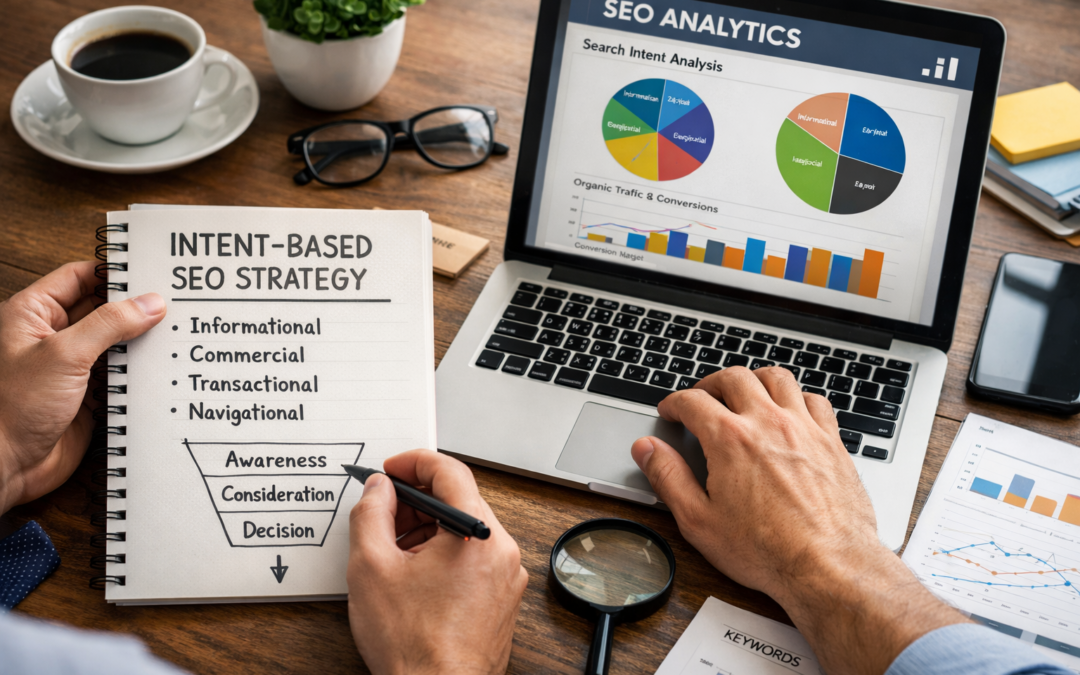
There are four primary types of search intent:
- Informational: Users are looking to learn or understand something.
- Navigational: Users want to reach a specific website or brand.
- Commercial investigation: Users are comparing options before making a decision.
- Transactional: Users are ready to take action or purchase.
An intent-based SEO strategy intentionally maps content to these stages instead of relying solely on high-volume keywords.
Step 1: Identify Intent Behind Your Target Keywords
Keyword research is still foundational, but intent analysis must come first. High search volume means little if the traffic does not match your goals.
Start by analyzing the search engine results pages for your target keywords. Look at:
- The types of content ranking on page one
- Content format such as blogs, videos, product pages, or guides
- The language used in titles and meta descriptions
If Google is ranking how-to guides and explainer articles, the intent is informational. If product pages and service pages dominate, the intent is transactional or commercial.
Group keywords not only by topic but by intent category. This ensures that each piece of content has a clear purpose and audience readiness level.
Step 2: Map Content to the Buyer’s Journey
Intent-based SEO works best when paired with a clear understanding of the customer journey. Each stage requires a different type of content.
At the awareness stage, users are identifying a problem or opportunity. Content here should educate and provide clarity. Examples include blog posts, beginner guides, and definitions.
At the consideration stage, users are exploring solutions. This is where comparison content, case studies, and in-depth guides perform best.
At the decision stage, users are ready to act. Service pages, product pages, demos, and testimonials support transactional intent.
Mapping your content across these stages helps prevent gaps where traffic enters your site but has no clear next step.
Step 3: Create Content That Fully Satisfies Intent
Once intent is defined, your content must deliver exactly what the user expects and then go a step further.
For informational intent, this means clear explanations, structured formatting, and thorough answers. Avoid sales-heavy language too early, as it can undermine trust.
For commercial investigation intent, transparency is critical. Highlight benefits, limitations, comparisons, and real-world use cases.
For transactional intent, remove friction. Make it easy to convert with clear calls to action, trust signals, and concise value propositions.
Search engines increasingly reward content that demonstrates depth, relevance, and user satisfaction. Thin content rarely performs well in an intent-driven landscape.
Step 4: Optimize for Semantic Search and Context
Search engines no longer rely on exact-match keywords alone. They interpret context, relationships, and meaning.
To support intent-based SEO:
- Use related terms and natural language variations
- Answer follow-up questions within the same piece of content
- Structure content with clear headings and logical flow
This approach improves topical authority and helps your content rank for a wider range of relevant queries without keyword stuffing.
Internal linking also plays a key role. Link informational content to consideration and decision-stage pages to guide users naturally through the funnel.
Step 5: Align SEO Metrics With Conversion Goals
Traditional SEO metrics like rankings and traffic are no longer enough. Intent-based strategies require deeper performance analysis.
Track metrics such as:
- Engagement time by intent category
- Conversion rates from organic traffic
- Assisted conversions across the funnel
- Content drop-off points
This data reveals which types of intent drive real business outcomes. It also helps refine future content planning based on what actually converts.
SEO and conversion optimization should work together, not in isolation.
Step 6: Continuously Refine Based on User Behavior
Search intent is not static. User expectations change, competitors evolve, and search engines update how they interpret queries.
Regularly review top-performing pages and underperforming ones. Ask:
- Is the intent still the same?
- Does the content still match what users want?
- Are there new formats or angles dominating search results?
Refreshing content to better match current intent often delivers faster gains than creating new pages from scratch.
Why Intent-Based SEO Drives Better Results
Intent-based SEO bridges the gap between traffic and revenue. Instead of chasing visibility alone, it focuses on relevance, timing, and usefulness.
Brands that adopt this strategy see stronger alignment between content and conversions, improved trust with their audience, and better long-term SEO performance.
When you stop optimizing for keywords and start optimizing for people, search engines follow.
Final Thoughts
Building an intent-based SEO content strategy requires more upfront thinking, but the payoff is substantial. By understanding why users search, aligning content with their journey, and measuring success beyond rankings, you create a system that supports both growth and conversions.
SEO is no longer about being found. It is about being chosen.

