by Research Team | Sep 7, 2026 | Digital Marketing Audits, PPC and Paid Ads, SEO
Getting an audit sounds simple. Most business owners have no idea what the process actually involves until they are in the middle of it.
A marketing audit process follows a fairly consistent set of steps, regardless of who is running it. This post walks through what happens at each stage, and what you actually receive at the end.
What the marketing audit process typically covers
A digital marketing audit typically covers some combination of technical SEO, content, PPC performance, and backlink health, depending on what was requested.
Scope varies by business. A technical-focused audit will spend more time on crawling and indexing, while a broader audit spreads attention across more categories at a lighter depth.
This is a diagnostic process, not a redesign. The goal is to identify what is happening on the site and in the accounts right now, not to rebuild anything during the audit itself.
The data-gathering stage
Data gathering comes first. This typically includes a full site crawl, a review of analytics, access to ad accounts, and a look at current rankings for relevant keywords.
This stage depends heavily on the business granting access to the right accounts. Without analytics or ad account access, an audit can only work from what is publicly visible, which limits how complete the findings can be.
The more complete the access, the more complete the picture. A partial audit built on limited access will often miss something a full one would catch, especially when tracking gaps sit behind a login an auditor was never given.
The analysis stage and how findings get prioritized
Raw data does not become useful on its own. The analysis stage is where it gets filtered into findings, then ranked by severity and business impact.
This is different from simply listing every technical issue found on a site. A hundred minor issues matter less than three that are actively costing traffic or conversions.
Business context shapes this ranking too. An issue on a page that drives most of a business’s leads matters more than the same issue on a page nobody visits.
What this looks like in practice from intake to findings
In practice, this process often surprises business owners. One business expected a short checklist and instead received a structured report with findings ranked by priority.
The digital marketing audit process for that business surfaced a tracking gap and a content issue that a surface-level review would have missed entirely. Neither problem was visible without pulling analytics and crawl data together.
Once those two findings were addressed, the business had a much clearer picture of where its marketing budget was actually working, and where it was not.
What you actually receive at the end of an audit
A marketing performance report is the typical deliverable. It includes the findings themselves, a priority ranking, and recommended next steps for each one.
The report is meant to be actionable, not just descriptive. A good one tells a business what to fix first and roughly why, not just what was found.
The audit itself does not include implementation, unless that work is separately scoped. Fixing what the report identifies is a distinct next step, not part of the audit process itself.
Frequently asked questions
Business owners tend to ask similar questions before commissioning their first marketing audit.
How long does a marketing audit process take?
This depends on scope, but most audits take one to three weeks from data gathering to a completed report. A narrower audit tends to move faster than a broad one.
Do I need to give access to my ad accounts and analytics?
Yes, for the most accurate results. Without this access, an audit can only work from what is publicly visible, which limits how complete the findings can be.
Will the audit tell me exactly what to fix first?
Yes. A useful audit report ranks findings by priority rather than listing every issue with equal weight, so the most important fixes are clear.
Does an audit include making the actual fixes?
No, not typically. An audit identifies what needs to change. Implementing those changes is usually a separate, follow-on step.
Key Takeaways
– A marketing audit process typically covers technical SEO, content, PPC, and backlinks, depending on scope.
– Full account access produces more complete findings than a review based only on public data.
– Findings are ranked by severity and business impact, not listed in equal weight.
– The audit deliverable is a prioritized report, not the implementation of the fixes themselves.
About the audit process behind this post
This walkthrough reflects the audit process used at Online Marketing Goddess. The agency’s approach draws on a published book on incremental marketing budgets and ongoing speaking engagements on SEO and PPC strategy for small businesses.
See what the process would reveal for your business
The process is straightforward, even if what it finds is not always expected. Get an Audit and see exactly what it would reveal for your marketing, step by step, from intake through the final report.

by Research Team | Aug 30, 2026 | Digital Marketing, PPC and Paid Ads
A missed click is not a lost customer. It is an unfinished conversation.
Most people who click a pay-per-click (PPC) ad do not buy on the first visit. They research, compare, and get distracted before coming back, if they come back at all.
This post covers why that first-visit drop-off happens, and how a PPC retargeting strategy brings that traffic back with a better chance of converting.
Why most PPC clicks don’t convert the first time
A first-time visitor rarely has enough information to buy right away. They are still comparing options, checking reviews, or simply not ready yet.
A PPC retargeting strategy exists specifically to recover this traffic. It is not a separate campaign type so much as a second opportunity aimed at people who already showed interest once.
Treating every click as a one-shot sale ignores how most buying decisions actually happen. Retargeting is how that gap gets closed.
Building a PPC retargeting strategy by segmenting your audience
A PPC retargeting strategy starts with segmenting by behavior, not by treating every past visitor the same way. A PPC ads agency typically builds this into every account from the start. Site visitors, cart abandoners, and past customers are three distinct groups with three different reasons to come back.
Each of these groups needs a different message. Someone who only viewed a homepage is still forming an opinion, while someone who abandoned a cart with a product already picked out is much closer to a decision.
Broad, unsegmented retargeting wastes spend on the wrong message. Grouping all past visitors into one audience is one of the most common ways retargeting budget gets wasted.
What makes retargeting ad copy and creative different
Retargeting messaging should acknowledge prior interest, not repeat the same cold-traffic pitch. A visitor who has already seen the brand does not need to be introduced to it again.
A common mistake is running the exact same ad creative for cold and retargeted audiences. The message that earns a first click is rarely the message that earns a second one.
Frequency capping matters here too. An ad that follows someone too often stops feeling helpful and starts feeling like a nuisance.
What this looks like in practice for an ecommerce PPC account
In practice, this shows up often. An account was running retargeting ads, but using the same generic creative shown to cold traffic.
Return on that retargeting spend was barely better than the cold campaigns it was supposed to outperform. The audience had already seen the ad once and had no new reason to act on it.
Once retargeting was segmented by behavior and the messaging was adjusted for each group, conversion rate on retargeted traffic rose well above the cold campaign baseline within the same budget.
What to measure to know if retargeting is working
Retargeting conversion rate compared against cold traffic conversion rate is the clearest signal. Retargeting should convert at a meaningfully higher rate, since the audience already has some familiarity with the brand.
Frequency is the second metric worth watching. Climbing frequency with flat or falling conversion rate usually means an audience has been shown the same ad too many times.
Cost per conversion rounds this out. A well-segmented retargeting campaign should produce a lower cost per conversion than the cold campaigns feeding it.
Frequently asked questions
Business owners tend to ask similar questions once they notice retargeting ads following the same customers repeatedly.
What is PPC retargeting?
PPC retargeting shows ads to people who have already visited a website or interacted with a brand, rather than to a fresh, unfamiliar audience.
How is retargeting different from a regular PPC campaign?
Retargeting uses a warmer audience and different messaging than a cold campaign. The goal is to bring back someone who already showed interest, not to introduce the brand for the first time.
How often should someone see a retargeting ad?
There is no single universal number, but frequency capping should prevent the same person from seeing an ad so often that it starts to feel intrusive rather than helpful.
Does retargeting work for every business?
It depends on traffic volume and sales cycle length. A business with very little traffic or a very short sales cycle may see less benefit than one with steady traffic and a longer decision process.
Key Takeaways
– Most PPC clicks do not convert on the first visit, which is exactly what a PPC retargeting strategy is built to address.
– Segmenting audiences by behavior matters more than running one generic retargeting campaign.
– Retargeting ad copy should acknowledge prior interest instead of repeating cold-traffic messaging.
– Retargeting should convert at a meaningfully higher rate than cold campaigns when it is working.
See what a real retargeting strategy could recover
If your retargeting ads look identical to your cold campaigns, that missed traffic is still missed. Schedule a Call to see what a segmented retargeting strategy could recover from clicks you already paid for.

by Research Team | Aug 28, 2026 | PPC, PPC and Paid Ads, SEO
More ad spend is the default reaction when ecommerce pay-per-click (PPC) conversions stall. It is rarely the right fix.
If clicks are coming in but sales are not, the problem usually is not visibility. Something between the click and the checkout page is breaking down.
This post covers where ecommerce PPC conversions typically break, and what to check before raising your budget.
What a low ecommerce PPC conversion rate is actually telling you
Ecommerce PPC conversion rate measures how many clicks turn into purchases, not how many people see or click an ad. A low number here points to a different problem than a low click-through rate does.
A traffic problem means the wrong people are seeing the ad. A conversion problem means the right people are clicking, but something after the click stops them from buying.
Adding budget to a traffic problem can help. Adding budget to a conversion problem just means paying for more of the same clicks that were never going to convert.
Product feed issues that quietly cap shopping ads performance
Shopping and Performance Max ads depend entirely on product feed data. If the feed is wrong, the ad is wrong, no matter how well a PPC ads agency structures the campaign around it.
Common feed problems include missing GTINs, vague or truncated titles, incorrect product categories, and items still running as available after they sell out.
Google’s Search Central documentation confirms that structured data and Merchant Center feed data work together to determine whether a product is eligible for shopping experiences. Errors like the wrong category, missing GTIN values, or low-quality images can quietly restrict which shoppers ever see a listing.
These issues often get mistaken for a targeting problem. In reality, the campaign may be targeting the right audience with a feed that is actively working against it.
Landing page mismatches that break the conversion path
An ad should lead to the exact product it promoted, not a category page or the homepage. That continuity between ad and landing page is where a lot of ecommerce PPC conversions are lost.
A shopper who clicks an ad for a specific product expects to land on that product, not a search results page inside the site. Every extra step is a chance to lose them.
Slow mobile load speed compounds the problem. A shopper who clicks with intent to buy will not wait long for a page to load before giving up.
What this looks like in practice for an ecommerce PPC account
In practice, this pattern shows up often. An account has a strong click-through rate and healthy ad spend, but conversion rate stays flat month after month.
A closer look typically finds the targeting was never the issue. Several product ads pointed to outdated landing pages, and a portion of the feed had disapproved listings pulling in the wrong search terms.
Once the feed was corrected and landing pages were matched to their ads, conversion rate improved within the same campaign structure and budget. No targeting changes were needed.
What to measure before increasing ad spend
Conversion rate by individual product is worth checking first, since an account-level average can hide products that are converting well next to products that are not converting at all.
Landing page bounce rate on paid traffic is the second signal. A high bounce rate on pages ad clicks land on points to a mismatch, not a targeting issue.
Feed disapproval count in Merchant Center is the third check. A budget increase should follow a fix to these signals, not replace one.
Frequently asked questions
Ecommerce business owners tend to ask the same questions once PPC traffic looks fine but sales do not follow.
Why is my ecommerce PPC getting clicks but no sales?
Clicks without sales usually point to a conversion problem, not a traffic problem. The right people are clicking, but something in the feed, landing page, or checkout path is stopping them from buying.
How does my product feed affect PPC performance?
Product feed data determines what shows in an ad and whether it is eligible to run at all. Missing or incorrect data can cause disapprovals or limited visibility that has nothing to do with campaign targeting.
Should I increase my ad budget if conversions are low?
Not before checking the feed and landing pages first. Increasing budget on a conversion problem typically pays for more of the same clicks that were never going to convert.
What is a good ecommerce PPC conversion rate?
This varies widely by product category and price point, so there is no single benchmark that applies across the board. The more useful comparison is your own account’s trend over time.
Key Takeaways
– A low ecommerce PPC conversion rate usually signals a problem after the click, not a targeting problem.
– Product feed data quality directly affects whether shopping ads are eligible to show at all.
– Landing pages should match the exact product an ad promotes, not a category page or homepage.
– Budget increases should follow a fix to feed and landing page issues, not replace one.
Find out what is actually blocking your ecommerce conversions
If clicks keep coming in without the sales to match, the fix is rarely a bigger budget. Get an Audit and find out exactly where your ecommerce PPC conversions are breaking down.

by Research Team | Aug 23, 2026 | PPC and Paid Ads, SEO, White Label Marketing
Getting a digital marketing audit report is one thing. Knowing what to actually do with it is another.
Most reports arrive dense with findings, some urgent and some minor, with little indication of which is which. That gap between receiving a report and acting on it is where a lot of value gets lost.
This post covers how to read a digital marketing audit report. It explains what the common terms mean and how to decide what to fix first.
What a digital marketing audit report actually contains
A digital marketing audit report typically covers technical findings, content gaps, PPC performance notes, and backlink health. Which areas get covered depends on what was requested.
Not every audit covers every category. A technical-focused audit goes deep on crawling and indexing. A broader audit spreads attention across more areas at a lighter depth.
A report is a diagnosis, not a to-do list on its own. It tells you what is happening on the site. Deciding what to do about it is a separate step.
How to tell which findings matter most
Severity matters more than volume. One high-impact issue can outweigh ten minor ones that never meaningfully affect traffic or conversions.
High-impact categories tend to repeat across reports. Common ones include indexing problems, broken conversion tracking, and content gaps on revenue-driving pages.
Business context changes the weight of a finding too. A slow load time on a rarely visited page matters less. The same issue on a page that drives most of your leads matters much more.
Common terms that show up in audit reports and what they mean
A few terms show up often enough to be worth defining plainly, without turning this into a full glossary.
Crawl budget refers to how much attention a search engine gives to crawling a site’s pages within a given period.
Conversion tracking refers to the setup that records when a visitor completes a goal, like a purchase or a form submission.
Canonicalization is how search engines pick one main URL. This happens when several pages have duplicate or near-duplicate content, according to Google’s own documentation.
A report that flags a canonical issue is usually pointing to duplicate versions of the same page competing with each other.
What this looks like in practice when prioritizing fixes
In practice, a single report can easily list 40 or more findings, and most of them will be minor.
One business received a report like this and initially felt overwhelmed by the volume.
A closer review found that three findings, out of more than 40, were driving nearly all of the site’s underperformance. Broken conversion tracking was one. A blocked category of product pages was another. So was a content gap on the site’s highest-traffic topic. Together, these three accounted for most of the impact.
Addressing those three first, before touching the smaller items, produced measurable improvement within the same quarter. The other 37 findings mattered less than their sheer number suggested.
What to measure after acting on audit findings
Organic traffic, conversion rate, and total indexed pages are worth revisiting at 30, 60, and 90 days after fixes go live.
Not every fix shows impact on the same timeline. A broken tracking fix can show results almost immediately. A content gap fix may take a full quarter to show up in rankings.
A realistic expectation matters here. Steady improvement across these metrics is a better sign than a single dramatic spike that may not hold.
Frequently asked questions
Business owners tend to ask similar questions after receiving an audit report for the first time.
What’s the difference between a technical finding and a content finding?
A technical finding relates to how a search engine can crawl, index, or load a site. A content finding relates to what is written on the page and whether it matches what searchers are looking for.
How many issues does a typical audit report find?
The number varies widely and is not itself a sign of how serious a site’s problems are. A short report can contain one critical issue, and a long one can contain mostly minor notes.
Should I fix everything in the report at once?
No. Fixing the highest-impact findings first tends to produce faster, clearer results. Working through the list in the order it was written usually does not.
How soon should I see results after fixing audit findings?
This depends on the type of fix. Tracking and indexing fixes can show results within weeks. Content and structural fixes often take a full quarter or more.
Key Takeaways
– A digital marketing audit report is a diagnosis, not a ready-made action plan.
– Severity, not volume, should determine which findings get addressed first.
– A small number of high-impact fixes usually matter more than a long list of minor ones.
– Different fixes show results on different timelines, and that is normal.
Get a report you will actually know how to use
An audit report only helps if you know what to do with it. Get an Audit that comes with clear priorities, not just a list of findings.
by Research Team | Aug 21, 2026 | Digital Marketing Audits, PPC and Paid Ads, SEO
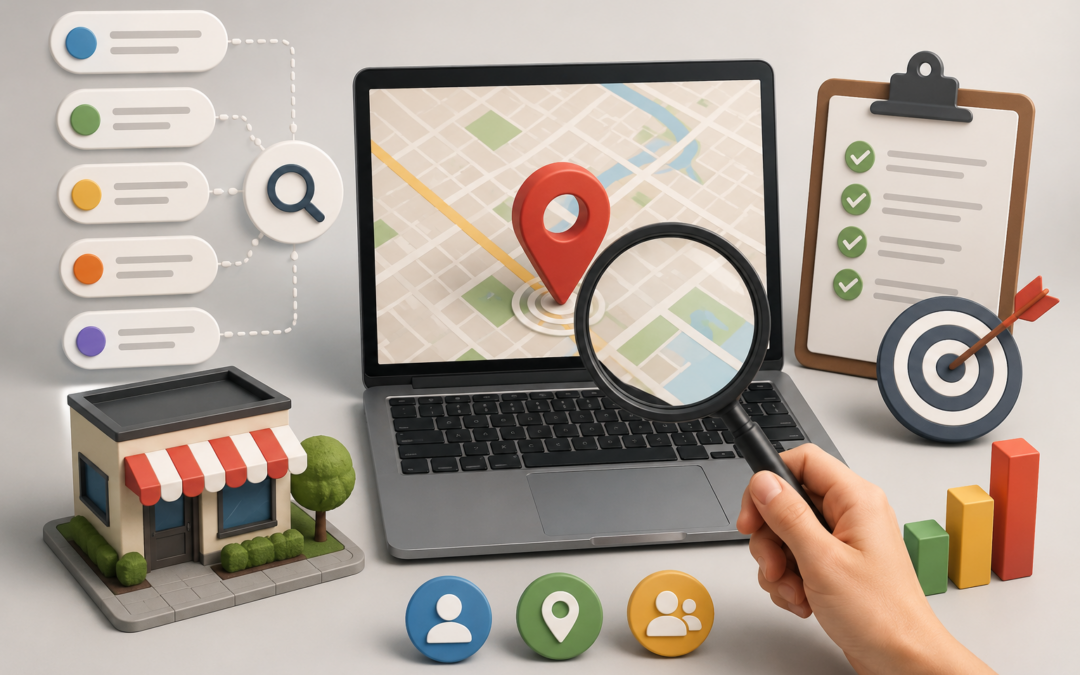
Most local service businesses guess at keywords instead of researching them. They pick terms that sound right, not terms their actual customers type into Google. That gap quietly caps how many of the right customers ever find them, and it’s often the first sign a business needs a closer look at search engine optimization (SEO) fundamentals. This post walks through how to choose keywords for local SEO with a framework you can use today.
How to Choose Keywords for Local SEO
Local keyword research starts with customer language, not assumptions. A national retailer and a local service business need different terms, even if they sell similar things. Local intent almost always includes a place, a service, and an urgency signal, like “same-day” or “near me.” The framework below builds outward from your services to the exact phrases customers use.
Start with the services you actually want more leads for
Before you research a single keyword, list the services you want to grow. Each service deserves its own page, not a shared spot on one general services page. A roofer offering repairs, replacements, and inspections needs three distinct pages, not one.
Prioritize this list by profit margin and current lead volume. Services that make the most money or already generate some interest deserve keyword research first.
The actionable step here is simple. Write down your core services before you open any research tool, then rank them by business priority.
Add location modifiers the way real customers search
Once you have your service list, add location terms the way customers actually search, not the way a directory listing might. That includes city names, neighborhood names, and phrases like “near me” or “in [service area].”
A Search Engine Journal guide to optimizing your Google Business Profile recommends working relevant keywords and search phrases naturally into your profile description, the same way you would on a website page. That habit is worth carrying over to your site copy too, rather than treating your profile and your website as two separate keyword strategies.
Avoid stacking city names unnaturally into a single sentence. One clear, natural mention per page reads better and performs better than a forced list.
Check search intent before committing to a keyword
Not every keyword that mentions your service is worth targeting. Some searches are informational, like “how does a roof inspection work.” Others are transactional, like “roof inspection near me.” Search Engine Journal’s keyword research guide frames this as matching a keyword to the page that best answers the underlying query, since queries fall into informational, navigational, and transactional categories.
Before committing to a keyword, check what’s currently ranking for it. If the top results are all blog posts answering a question, that term likely won’t convert on a service page.
The fix is a quick manual check. Search the term yourself and look at what Google is already showing before you build a page around it.
Use competitor gaps to find keywords they’ve missed
Similar businesses in your market often miss service-area or service-type combinations. One might rank well for general repair terms but skip newer service lines or specific neighborhoods entirely.
Run a gap analysis against the businesses currently ranking above you. Note which service pages or location pages they’re missing, and use that list to prioritize your next round of content.
Review and refine your keyword list on a regular basis
Search behavior shifts as your service area, competitors, and customer base change. A keyword list built two years ago rarely reflects how customers search today.
In practice, this shows up gradually. One local service client had never reviewed their keyword list after the initial setup. A review found they were missing pages for two neighborhoods generating steady search volume, and one service page was targeting a term with almost no local search activity at all. Neither gap was visible without a structured review.
The step here is straightforward. Put a recurring keyword review on the calendar, at least once or twice a year, and adjust your pages as your business and market change.
A solid keyword list is the foundation, but turning it into pages that actually rank usually takes ongoing, hands-on execution most businesses don’t have the bandwidth to sustain alone.
Frequently asked questions
Here are a few common questions local business owners ask when they start keyword research.
How many keywords should a local business target?
The right number depends on how many services and service areas you cover. A business with three services and two locations needs a smaller list than one with ten services across a wider region.
Should I include my city name in every page title?
Include it where it reads naturally, usually once per title. Stacking multiple city names into a single title looks forced and can hurt readability more than it helps rankings.
What’s the difference between local SEO and regular SEO?
Local SEO adds a geographic and intent layer on top of standard SEO. It focuses on searches tied to a location and a specific service, rather than broad national terms.
How do I find out what keywords my customers actually use?
Check your Google Business Profile insights, your website’s search console data, and the language customers use in reviews and phone calls. These sources reflect real search behavior, not guesses.
Key Takeaways
– Local keyword research starts with your service list, not a generic keyword tool search.
– Location modifiers should match how customers actually search, not a forced list of city names.
– Checking search intent before building a page prevents wasted content and wasted budget.
– A regular keyword review catches gaps that stay invisible without a structured check.
Work With Me
Choosing the right keywords is only the first step. Turning that list into pages that actually rank takes ongoing strategy. If your local service business isn’t showing up for the searches that matter, an SEO expert can help you build a plan tied to real search behavior. Work With Me to build a keyword strategy that’s actually built around your customers.

by Research Team | Aug 18, 2026 | Digital Marketing Audits, Marketing Strategy, PPC and Paid Ads, SEO
Your traffic can drop, your leads can slow down, and your website can look fine on the surface the whole time. Most business owners don’t know they have search engine optimization (SEO) problems until they run a full SEO health check. This post walks through the signs you need an SEO audit and the practical step to take for each one.
How do you know you need an SEO audit?
Some SEO problems are loud. Others sit quietly in the background for months. A dip in leads, a plateau in traffic, or a slow decline in rankings can all point to the same root cause: an SEO issue that has never been diagnosed. The signs below are the ones that come up most often when a business finally runs an audit.
Your organic traffic has dropped without a clear reason
A sudden drop usually points to one cause: a technical error, a security issue, or an algorithm update. A slow, gradual decline often points to something different, like content that has aged out of relevance or competitors that have closed a gap.
If you’re not running SEO checks regularly, this kind of decline can go unnoticed for months. Google’s own guidance on debugging traffic drops recommends reviewing your Search Console performance data by page and query before assuming anything is broken.
The actionable step here is straightforward. Pull your Search Console data, segment it by page and query, and look for the point where the trend line changes.
Your website ranks for the wrong keywords
Impressions can look healthy while clicks stay flat. That pattern usually means your pages rank for terms that don’t match what searchers actually want. A blog post might rank for a broad, informational term when the page itself is trying to sell a service.
This mismatch is common and fixable. A technical SEO audit checklist typically includes a review of keyword-to-page mapping, so each page targets the intent it was built for.
The fix starts with a simple comparison. Match your top pages against the keywords they currently rank for, and flag any page where the two don’t line up.
Technical SEO problems are quietly costing you visibility
Site speed, mobile usability, and crawl errors rarely announce themselves. A slow page or a broken redirect chain won’t trigger an alert. It just costs you visibility, one small percentage at a time.
Google’s guidance on Core Web Vitals points to loading speed, interactivity, and visual stability as the three factors it measures for page experience. In practice, a digital marketing audit almost always surfaces at least one of these issues on a site that hasn’t been checked recently.
The step to take now is a full technical crawl. Check for broken links, slow-loading pages, and mobile display issues before they compound further.
Your competitors are outranking you for terms you should own
If a similar business in your space consistently outranks you for the terms that matter most, the gap is usually one of three things: content depth, backlink strength, or on-page optimization. None of these are permanent. All of them are diagnosable.
Run a gap analysis against the pages currently outranking yours. Note what those pages cover that yours doesn’t, and use that list to prioritize your next content updates.
You haven’t reviewed your SEO performance in the last 6 to 12 months
Search behavior changes even when your website doesn’t. A page that ranked well a year ago can quietly lose ground as competitors update their content and Google refines its systems.
In practice, this shows up as a slow fade rather than a dramatic drop. One ecommerce client hadn’t reviewed their site in over a year. Their audit found a 22 percent gap between impressions and clicks, along with three product pages that had dropped out of the top 20 results entirely. None of it was visible without a structured review.
The step here is simple: put a recurring review on the calendar. Once or twice a year is a reasonable starting point for most small businesses.
Frequently asked questions
Here are a few common questions business owners ask once they suspect an SEO problem.
How often should a business get an SEO audit?
Once a year is a reasonable baseline for most small businesses. Ecommerce sites or businesses in competitive markets often benefit from checking every six months instead.
What does an SEO audit check?
A full audit typically reviews technical health, on-page optimization, content quality, and backlink profile. Some audits also review keyword-to-page mapping and site structure.
Can I tell if my site has SEO problems without an audit?
Some signs are visible, like a traffic drop or a keyword mismatch. Others, like a slow technical issue or a content gap, usually stay hidden until a structured audit surfaces them.
How long does an SEO audit take?
Timelines vary by site size and complexity. A small business site typically takes less time to review than a large ecommerce catalog with thousands of pages.
Why do you need an SEO audit?
You need an SEO audit when you cannot explain what your traffic is doing. Most sites lose visibility slowly, through aging content, technical faults that never trigger an alert, and competitors closing gaps you have not looked at. None of that announces itself. An audit turns a vague sense that something is off into a specific, ordered list of what to fix first.
How much does an SEO audit cost?
An SEO Audits start at $497 and the audit is usually priced on the size and complexity of the site rather than by the hour. A small business site with a few dozen pages takes far less review than an ecommerce catalogue running thousands of product URLs. The other factor is depth: a technical-only crawl costs less than a full review covering technical health, content, keyword mapping and backlink profile.
Key Takeaways
– A sudden traffic drop and a slow decline usually point to different causes, and each needs its own fix.
– Ranking for the wrong keywords often shows up as high impressions and low clicks.
– Technical issues like site speed and crawl errors rarely announce themselves, but they cost visibility over time.
– A digital marketing audit turns these signs into a clear, prioritized action plan.
Get an Audit
You don’t need to guess which of these signs applies to your site. An SEO expert can walk through your traffic, rankings, and technical health in one review. Get an Audit and get a clear picture of where your traffic is going.