
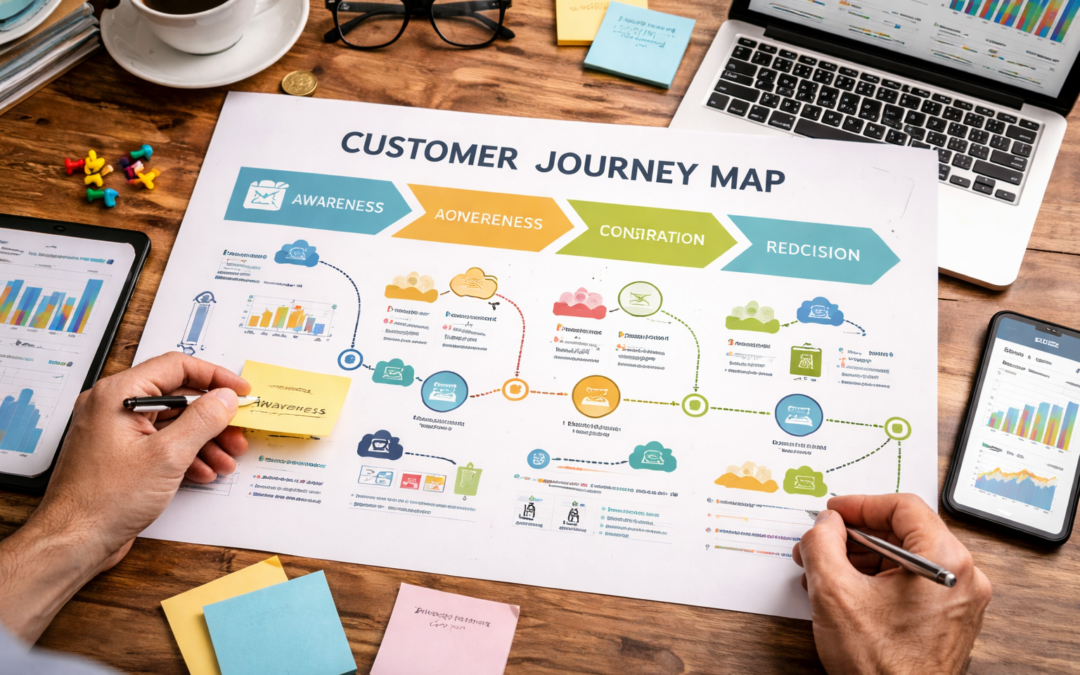
Marketing performance issues are rarely caused by a lack of effort. More often, they stem from a disconnect between how brands communicate and how customers actually experience the journey from first touch to conversion.
Customer journey mapping helps close that gap. By visualizing every interaction a customer has with your brand, marketers gain clarity on where friction occurs, where opportunities are missed, and where performance can be improved.
When used strategically, customer journey mapping becomes a powerful framework for optimizing campaigns, messaging, and conversions.
What Is Customer Journey Mapping
Customer journey mapping is the process of documenting and analyzing the steps a customer takes when interacting with a brand across channels and touchpoints.
This includes:
- Awareness and discovery
- Research and consideration
- Decision and conversion
- Post-purchase engagement and retention
A journey map focuses on customer behavior, motivations, emotions, and barriers, not just internal marketing activities. It shifts the perspective from what brands do to what customers experience.
Why Customer Journey Mapping Matters for Marketing Performance
Marketing performance improves when strategies align with customer reality. Journey mapping reveals where misalignment occurs.
Key benefits include:
- Identifying gaps between channels and messages
- Reducing friction that causes drop-offs
- Improving timing and relevance of campaigns
- Aligning teams around a shared customer view
- Increasing conversion rates and lifetime value
Without a clear journey map, marketing efforts often operate in silos, leading to inconsistent experiences and wasted spend.
Step 1: Define Your Customer Personas Clearly
Journey mapping starts with understanding who the journey belongs to. A single generic journey rarely reflects real behavior.
Define clear personas based on:
- Goals and pain points
- Buying motivations
- Objections and concerns
- Preferred channels and content formats
Each persona may follow a different path, even when purchasing the same product or service. Mapping journeys by persona ensures relevance and accuracy.
Step 2: Identify All Key Touchpoints
Touchpoints are every interaction a customer has with your brand, both direct and indirect.
Common touchpoints include:
- Search results and ads
- Blog content and landing pages
- Social media interactions
- Email campaigns
- Sales conversations
- Onboarding and support experiences
Map touchpoints across channels, not just owned platforms. Third-party reviews, referrals, and comparison sites often play a critical role in decision-making.
Step 3: Understand Customer Intent and Emotion at Each Stage
A strong journey map goes beyond listing steps. It captures intent and emotion at each stage.
Ask questions such as:
- What is the customer trying to achieve here?
- What questions or doubts do they have?
- What frustrations might they experience?
- What would build trust at this moment?
This insight helps marketers tailor messaging, content, and offers to match customer mindset instead of pushing premature calls to action.
Step 4: Identify Friction Points and Drop-Offs
Journey mapping exposes where performance breaks down.
Common friction points include:
- Confusing navigation or messaging
- Inconsistent information across channels
- Poor mobile experiences
- Lack of follow-up after engagement
- Misaligned offers or timing
Use data from analytics, CRM systems, and customer feedback to validate assumptions. High drop-off rates often indicate experience issues rather than demand problems.
Step 5: Align Marketing Channels to Support the Journey
Once friction points are identified, map each channel’s role in supporting the journey.
For example:
- SEO and content marketing support awareness and education
- Email nurtures consideration and trust
- Paid media accelerates decision-making
- Social proof reinforces confidence
- Post-conversion content supports retention
This alignment ensures channels work together rather than competing for attention.
Step 6: Optimize Content and Messaging by Stage
Customer journey mapping informs what content is needed and when.
At early stages, focus on education and problem definition.
At mid stages, provide comparisons, case studies, and deeper insights.
At decision stages, emphasize clarity, proof, and ease of action.
This approach prevents common mistakes such as pushing sales messages too early or overwhelming prospects with information at the wrong time.
Step 7: Use Journey Mapping to Improve Measurement
Journey mapping improves performance measurement by shifting focus from isolated metrics to holistic outcomes.
Instead of evaluating channels independently, assess how they contribute collectively to progression through the journey.
Key metrics may include:
- Assisted conversions
- Time between stages
- Engagement by journey stage
- Retention and repeat behavior
This perspective leads to more accurate attribution and smarter optimization decisions.
Step 8: Keep the Journey Map Updated
Customer behavior evolves. Platforms change. Expectations shift.
Journey maps should be reviewed regularly and updated based on:
- New data insights
- Changes in offerings
- Feedback from sales and support teams
- Market and competitive shifts
Treat the journey map as a living document, not a one-time exercise.
Common Mistakes to Avoid
Customer journey mapping fails when:
- It is created without real customer data
- Teams treat it as a visual exercise only
- Insights are not acted upon
- Ownership is unclear
The value lies not in the map itself, but in how it informs decisions.
Strategic Insight
Customer journey mapping improves marketing performance by aligning strategy with real customer behavior. It reveals where marketing supports progress and where it unintentionally creates friction.
Brands that invest in understanding and optimizing the journey create more consistent experiences, stronger trust, and better results across channels.
When marketing decisions are guided by the customer journey, performance becomes a natural outcome rather than a constant struggle.
