
by Research Team | Dec 17, 2025 | Artificial Intelligence, Digital Marketing, SEO, Voice Search
Search is evolving faster than ever. What began as a text-based activity has expanded into a world of voice commands, camera scans, and multimedia queries. Today’s consumers don’t just type—they speak, snap, and stream their way to the information they need.
This shift toward voice and visual search convergence is transforming how people discover products, brands, and content online. As these technologies merge, businesses must adapt their digital marketing strategies to stay visible and relevant across this new spectrum of search behavior.
The Rise of Multi-Modal Search
Voice and visual search are no longer futuristic concepts—they’re here, integrated into the platforms people use daily.
Smart speakers, mobile assistants, and AI-driven apps have made voice search a natural part of everyday life. Users now ask their devices to find nearby restaurants, track deliveries, or shop hands-free. At the same time, visual search—where users upload or capture images to search for similar items—has grown rapidly through tools like Google Lens, Pinterest Lens, and Snapchat’s visual shopping features.
The convergence of these modes means users can now combine voice, visuals, and context in a single search. Imagine saying, “Find me shoes like this,” while pointing your phone camera at a photo. Search is becoming intuitive, conversational, and highly visual.
Why Voice and Visual Search Matter for Marketers
Traditional SEO is no longer enough to reach consumers who are shifting from typing to talking and scanning. Here’s why voice and visual optimization should now be part of every marketer’s toolkit.
Changing Search Behavior
More than half of online consumers use voice search regularly, and visual search is rapidly gaining ground, especially among younger demographics. These users expect speed, accuracy, and convenience—qualities that text-based search alone can’t always deliver.
Contextual and Intent-Driven Queries
Voice and visual inputs often signal higher intent. A person who takes a picture of a product or asks a voice assistant for “the best local repair service near me” is often ready to act. Marketers who optimize for these micro-moments can capture customers precisely when they’re ready to engage.
Platform Integration
From Google and Amazon to TikTok and Instagram, major platforms are blending search technologies. Optimizing for voice and visual discovery ensures your content remains discoverable across these interconnected ecosystems.
How Voice and Visual Search Work Together
Voice and visual search share one important characteristic: they rely on AI interpretation to understand user intent.
Voice search depends on natural language processing (NLP) to interpret spoken queries, analyze tone, and provide relevant results.
Visual search uses computer vision and machine learning to identify objects, colors, patterns, and context within an image or video.
As these technologies converge, they create what’s known as multi-modal search, allowing users to combine voice, text, and visuals seamlessly. For example, a shopper could take a photo of a lamp, ask their smart assistant about similar styles, and receive personalized recommendations—all within seconds.
This blend of sensory inputs represents the next phase of digital interaction: a world where devices understand not just what we type, but what we see and say.
Preparing Your Digital Strategy for the Shift
To succeed in this new search landscape, marketers must evolve beyond keywords and embrace optimization strategies that cater to both voice and visual queries. Here’s how to prepare.
Optimize for Conversational Queries
Voice searches are longer, more conversational, and often phrased as questions. Instead of targeting short keywords like “best running shoes,” focus on natural phrases such as “What are the best running shoes for long-distance runners?”
Create FAQ pages and blog posts that address these queries directly. Incorporate schema markup to help search engines understand your content’s context and improve visibility in featured snippets and voice results.
Strengthen Local SEO
Many voice searches are location-based (“near me” queries). Ensure your business listings are complete, accurate, and consistent across platforms like Google Business Profile, Apple Maps, and Yelp. Include local keywords, hours, and reviews to increase your chances of appearing in voice-driven local results.
Enhance Image and Video Metadata
Visual search engines rely heavily on metadata. Optimize all images and videos with descriptive filenames, alt text, and structured data. Include relevant keywords in your captions and ensure visuals are high-quality, properly sized, and mobile-friendly.
Leverage AI-Powered Product Tagging
If you sell products online, invest in AI-based tagging systems that automatically label your catalog images with attributes like color, style, and material. This makes your items easier to find through visual search platforms.
Prioritize Fast, Mobile-Optimized Experiences
Both voice and visual searches often happen on mobile devices. A slow-loading site or poor mobile UX can drive users away quickly. Use responsive design, compress media files, and test your site speed regularly to ensure smooth performance across all devices.
Integrate Structured Data and Schema
Structured data helps search engines understand relationships between your content and user intent. For example, schema markup for products, FAQs, and reviews can improve how your pages appear in rich results—critical for voice and visual discovery.
Emerging Technologies Driving the Convergence
The fusion of voice and visual search is powered by advances in artificial intelligence, natural language understanding, and computer vision. These technologies work together to make search experiences more intuitive and predictive.
- AR and VR integration: Platforms like Google AR and IKEA Place let users visualize products in their real environments using camera-based apps.
- Smart assistants with cameras: Devices like Amazon Echo Show and Google Nest Hub blend voice interaction with image recognition, enhancing the shopping and search experience.
- Video recognition search: AI can now analyze frames within videos, enabling users to find products or information mentioned or shown in a video clip.
As AI models continue to evolve, search engines will become even more capable of connecting spoken intent with visual context—making brand visibility across all media more important than ever.
Building a Future-Ready Marketing Approach
Preparing for voice and visual search convergence isn’t about reinventing your entire digital strategy; it’s about adapting your existing foundation for a multi-modal world.
Start by auditing your current content for accessibility, speed, and metadata completeness. Then, integrate conversational language, structured data, and rich visuals into every part of your digital ecosystem—from blog content and landing pages to product listings and social media posts.
The brands that thrive in this era will be those that think beyond keywords and focus on context—understanding how users search, not just what they search for.
The Future of Search Is Multi-Sensory
The line between seeing, saying, and searching is disappearing. As people continue to blend voice and visuals into their digital behavior, brands must learn to speak the same language—across text, tone, and image.
Voice and visual search convergence isn’t just a trend; it’s a fundamental shift in how discovery happens. By optimizing early and building adaptable, AI-friendly content, your brand can remain visible and relevant in the new age of intelligent, multi-sensory search.

by Research Team | Nov 30, 2025 | Content Marketing, Optimization, SEO
Search engines reward content that remains relevant, accurate, and valuable. As algorithms evolve, older content often loses visibility, even if it once performed well. A content refresh strategy helps brands revive underperforming pages, strengthen keyword alignment, and improve user experience. When done correctly, updating content is often more effective than creating new material from scratch.
Refreshing content gives marketers the opportunity to optimize for search trends, fix gaps, and improve clarity. This approach benefits websites that have been publishing for several years and want to strengthen long term organic performance. This article explains what a content refresh strategy is, why it matters, and how to implement it effectively.
Why Refreshing Existing Content Is a High-Value Strategy
Publishing new content remains important, but refreshing older material is one of the most efficient ways to improve organic reach. Several factors make this approach powerful.
Search behavior changes over time
Users search differently today than they did a year ago. New questions emerge, terms evolve, and new angles become relevant. Updated content performs better when it reflects current search intent.
Competitors add new content
Even if your article once ranked well, competitors may publish stronger material. Refreshing your content helps maintain authority and relevance.
Algorithms prioritize freshness
Search algorithms reward content that is maintained. Pages with outdated information may lose ranking even if the subject matter has not changed.
Updates improve user experience
Clearer structure, current data, and refined explanations help users stay engaged. Strong engagement signals improve search performance.
Refreshing costs less than creating new content
Updating an existing page requires less time and resources than producing a new one. The impact, however, can be significant.
Signs Your Content Needs a Refresh
Not all pages need updates. A strategic refresh begins by identifying the pages most likely to benefit from changes. Common indicators include:
- Steady decline in organic traffic
- High impressions but low clicks
- High bounce rates on older content
- Outdated examples or data
- Missing search terms your audience now uses
- Content that underperforms despite strong potential
Identifying these signals helps prioritize which pages to refresh first.
How to Build a High-Impact Content Refresh Strategy
A content refresh strategy works best when structured clearly. The steps below provide a framework that supports long term success.
Step 1: Audit your existing content
Begin by evaluating all published content. Categorize each page based on performance, topic relevance, and accuracy. Identify:
- High performing content to maintain
- Declining content that needs updating
- Outdated content that requires major revision
- Low value content that can be merged or removed
A thorough audit ensures efforts focus on the right pages.
Step 2: Review current search intent
Search intent often changes. Look at the keywords that bring users to the page, review competitor articles, and analyze related queries. Determine whether users now expect:
- A how to guide
- A comparison article
- A detailed explanation
- A quick definition
- A step by step process
Intent should guide how the content is structured.
Step 3: Update the information
Remove outdated data, refresh examples, and update statistics. Add new research when necessary. Ensure that every section reflects current best practices, audience behavior, and market trends.
Step 4: Improve structure and readability
Modern content needs to be clear and organized. Consider:
- Shorter paragraphs
- Updated headings
- Clear subtopics
- Lists or tables
- Stronger transitions
Improved structure helps both users and search engines.
Step 5: Strengthen keyword alignment
Include relevant keywords naturally throughout the content. Look for:
- Long tail variations
- Semantic alternatives
- Modern phrasing
- Questions users are currently asking
Avoid keyword stuffing. Instead, focus on clarity and relevance.
Step 6: Add new sections to expand value
If competitors cover topics your article does not, consider adding new sections. This helps the content stay competitive and meet user expectations.
Step 7: Optimize visuals
Add updated images, diagrams, or examples that support the content. Visuals improve engagement and help break up long sections of text.
Step 8: Enhance internal and external linking
Link to other relevant pages on your site. This strengthens topical depth and helps improve ranking. Include high quality external links when appropriate.
Step 9: Improve calls to action
Clear calls to action help guide users to the next step, whether that is downloading a resource, subscribing to updates, or reading related content.
Step 10: Republish and monitor performance
Once the updated content is live, track its performance. Measure changes in:
- Rankings
- Organic traffic
- Engagement metrics
- Click through rates
- Time on page
Performance data helps refine future refreshes.
Benefits of a Strong Content Refresh Strategy
Once updates are in place, the long term benefits become clear.
Enhanced search visibility
Updated content signals relevance. This improves ranking potential and supports consistent traffic.
Higher engagement
Users respond to clear, current, and valuable information. Better engagement strengthens overall SEO performance.
Better conversion opportunities
Improved structure and clarity help more readers take action. Refreshing content supports stronger leads and conversions.
Stronger content library
Maintaining your content library ensures every article contributes to your overall strategy. High quality content increases domain authority and strengthens brand perception.
Long term sustainability
A refresh strategy keeps your digital presence active and relevant, even as trends and algorithms shift.
Why Refreshing Content Should Be an Ongoing Practice
Refreshing content is not a one time task. Search behavior evolves and new competitors enter the market. Brands that treat content refreshes as a regular part of their strategy maintain stronger visibility and better performance.
Marketers who prioritize updates gain a measurable advantage. They improve rankings, increase engagement, and maximize the value of every piece of content they publish. A well planned content refresh strategy ensures long term success in an increasingly competitive digital landscape.

by Research Team | Nov 28, 2025 | B2B Marketing, SEO
Voice technology has changed the way people search for information. While it began as a convenience feature on mobile devices, voice search has now expanded into homes, vehicles, offices, and industrial environments. The shift toward hands free searching creates new opportunities for brands, especially those serving B2B and industrial markets. Companies that want to stay visible and competitive must begin optimizing content for the way people speak, not only the way they type.
This post explains how voice search works, why it matters in industrial and B2B settings, and what steps brands can take to improve visibility when customers use voice assistants to find solutions.
Why Voice Search Matters for Industrial and B2B Companies
Most discussions about voice search focus on consumer products. However, there is a growing adoption of voice enabled tools among field technicians, engineers, safety managers, procurement teams, and industrial buyers. These users often search while on the move or while working in environments where typing is inconvenient or unsafe.
There are several reasons voice search is becoming valuable in these sectors.
Many industrial workers rely on hands free technology
Utility crews, maintenance teams, and technicians often wear gloves, work in low light, or operate in hazardous environments. Voice search allows them to get information without stopping their work. This makes it easier for them to look up safety procedures, specifications, product compatibility details, or replacement parts.
B2B decision makers often search during fast moving workflows
Business buyers use voice assistants on mobile devices and laptops for quick research. When they need information during meetings or site visits, voice search offers an efficient way to gather details without interrupting work.
Search engines prioritize conversational content
Voice search queries are longer, more natural, and phrased as questions. Brands that create content aligned with these patterns increase their chances of appearing in featured snippets and answer boxes. This is especially useful in B2B because high quality snippets can influence major purchase decisions.
Early adopters gain a long term advantage
Many industrial and B2B brands have not yet optimized for voice. Companies that begin early can secure strong search positions before the competition catches up.
How Voice Search Works
Voice search uses natural language processing to understand spoken queries. These queries often fall into specific patterns. Understanding these patterns helps you structure content that matches user intent.
Common voice queries include:
- Direct questions
- How to requests
- Local searches
- Problem solving queries
- Comparisons between products or solutions
For example, instead of typing “industrial rainwear supplier,” a user might ask “Who makes durable rainwear for utility workers.” The difference may seem minor, but it impacts which content ranks.
Voice search favors answers that are:
- Clear
- Direct
- Structured
- Helpful in fewer words
- Matched to natural speech
This means content formatting plays an important role in voice search visibility.
Strategies to Optimize for Voice Search in Industrial and B2B Markets
Industrial and B2B companies can use several practical methods to improve voice search performance. The steps below focus on clarity, authority, and natural language structure.
Prioritize conversational keywords
Voice queries sound more like real sentences. Instead of relying only on short keywords, include long phrases that match the way people speak. Use question based variations that mirror field or office conversations. Review customer emails, support calls, and onboarding documentation to find natural phrasing.
Examples might include:
- How do I choose flame resistant gear for chemical plants
- What is the safest option for electrical utility rainwear
- Who supplies protective apparel for hazardous work sites
These phrases reflect spoken questions rather than typed keywords.
Create FAQ sections on key pages
FAQ blocks match the question answer structure preferred by voice search algorithms. Place these sections on product pages, service pages, and resource guides. Keep each answer short, clear, and accurate. When the content is structured in a straightforward way, search engines are more likely to select it as a spoken response.
Strengthen local and service area optimization
Many industrial buyers ask voice assistants to find suppliers in a specific region. Include accurate location data across your site, citations, and listings. When buyers use queries like “best industrial PPE supplier near me,” search engines will match your business with local intent.
Use structured data markup
Schema markup helps search engines understand your content more clearly. It signals what the page represents and improves your chance of appearing in featured snippets. Structured data is especially valuable for product pages, guides, and FAQs.
Write clear, concise answers at the top of long form posts
Voice assistants often read only the first few lines of an answer. Begin each section with a direct sentence that responds to the question. Follow that with longer explanations for readers who want more detail. This structure serves both voice search and traditional SEO.
Optimize for mobile users
Most voice searches happen on mobile devices. Ensure your website loads quickly, presents information clearly, and avoids clutter. Industrial buyers often work in the field, so speed and usability matter.
Publish content that solves real problems
Voice search favors content that addresses challenges. In industrial markets, these challenges often involve safety requirements, compliance needs, durability standards, and equipment maintenance. When your content solves real issues, it becomes more likely to match spoken intent.
The Long Term Outlook for Voice Search in B2B Markets
Voice search adoption will continue to grow as hands free technology becomes more common in industrial environments. Smart headsets, wearable devices, and voice enabled machines will increase usage even further. B2B buyers will continue to value quick, reliable answers during high pressure tasks.
Companies that adapt now will be better prepared for the future. Voice optimized content improves overall SEO, enhances customer experience, and strengthens your authority as a knowledgeable industry resource.
By aligning your content with the natural language patterns of voice search, you position your brand to meet the expectations of modern industrial and B2B customers.

by Research Team | Nov 25, 2025 | Content Marketing, Optimization, SEO
Ranking high on Google is no longer just about finding the right keywords—it’s about understanding the why behind the search. This is where search intent optimization comes in.
Search engines like Google are increasingly focused on delivering results that align with a user’s underlying motivation. So when someone types a query, the goal isn’t just to match the words—they want the right kind of answer. Marketers who align their content with search intent not only rank better but also convert more.
What Is Search Intent?
Search intent—also known as user intent—is the reason behind a user’s query. It’s the goal they hope to achieve when they type something into a search engine.
Search intent generally falls into four core categories:
1. Informational Intent
The user wants to learn something. These searches often start with:
- “How to…”
- “What is…”
- “Why does…”
- “Guide to…”
Example: “How does content atomization work?”
2. Navigational Intent
The user is trying to find a specific website or brand.
- “Facebook login”
- “Shopify help center”
- “Neil Patel blog”
Example: “Ahrefs keyword tool”
3. Transactional Intent
The user is ready to take action—usually a purchase, signup, or download.
- “Buy an ergonomic desk chair.”
- “Subscribe to Canva Pro”
- “Book a haircut near me”
4. Commercial Investigation
The user is comparing options before making a decision.
- “Best CRMs for small business”
- “iPhone vs. Samsung camera”
- “Webflow reviews 2025”
Understanding these categories helps shape your content to match the user’s mindset—not just their words.
Why Search Intent Matters for SEO and Conversions
1. Google Prioritizes Relevance
Google’s algorithms are increasingly designed to understand context. Even if your page is perfectly optimized for a keyword, it won’t rank if it doesn’t meet the searcher’s intent.
2. Reduces Bounce Rates
If your page matches what the user is looking for, they’ll stay longer. If it doesn’t, they’ll click away—and that signals poor relevance.
3. Improves Conversion Rates
When you speak with the right intent, your content moves users along the funnel naturally—from awareness to action.
4. Strengthens Content Strategy
Search intent helps guide what type of content to create for each stage of the buyer journey—from top-of-funnel education to bottom-of-funnel product pages.
How to Identify Search Intent
1. Look at the SERP (Search Engine Results Page)
Google often tells you exactly what users want. Type the query into the search and study the top-ranking results:
- Are they blogs, product pages, or videos?
- Are there featured snippets or “People also ask” boxes?
- Is Google showing local map results or shopping ads?
This will reveal whether Google sees the query as informational, transactional, or otherwise.
2. Pay Attention to the Language Used
Words like “buy,” “best,” “vs,” or “how to” are strong indicators of intent.
3. Use Keyword Tools
Some SEO tools now provide insight into search intent classifications and related long-tail variations.
How to Optimize for Different Types of Intent
Informational
- Create blog posts, how-to guides, and explainer videos
- Use headings and bullet points for easy scanning
- Provide actionable steps or answers early in the content
- Add internal links to deeper or related content
Example: A blog titled “How to Improve Website Accessibility” with subheadings, visuals, and a downloadable checklist.
Navigational
- Ensure your brand’s site is well-optimized and easy to find
- Use clear meta titles and brand signals
- Create dedicated landing pages for branded queries
Example: A landing page for “Zoom pricing plans” is clearly labeled and structured.
Transactional
- Optimize product or service pages with clear CTAs
- Include trust signals (reviews, badges, policies)
- Offer limited-time discounts or incentives
- Make navigation and checkout seamless
Example: A landing page for a subscription product with testimonials, FAQs, and a risk-free guarantee.
Commercial Investigation
- Write comparison posts or buyer guides
- Include product tables, pros and cons, and feature breakdowns
- Use schema markup for star ratings and rich snippets
- Keep content unbiased and focused on helping, not pushing
Example: “Top 5 Email Marketing Tools for 2025 Compared” with screenshots and use-case highlights.
Best Practices for Search Intent Optimization
1. Map Keywords to Intent in Your Strategy
Create a simple spreadsheet that assigns each target keyword to one of the four intent categories. This ensures content aligns with user needs from the start.
2. Re-optimize Existing Content
Audit your top pages. If a blog is ranking for a transactional query, consider turning it into a product page or linking it to one.
3. Use Clear CTAs Based on Intent
For informational content, guide users to more learning. For commercial content, present decision-making tools or demos.
4. Don’t Mix Intents on One Page
Each piece of content should focus on one primary intent. Mixing “learn more” with “buy now” can confuse users and hurt conversions.
Matching Content to Motivation
Search intent optimization is more than an SEO tactic—it’s a way to create truly helpful content that respects where users are in their journey.
By mapping intent, adjusting your format, and delivering the right experience at the right time, you don’t just improve rankings—you build trust, improve conversions, and create a better overall brand experience.

by Research Team | Nov 23, 2025 | Digital Marketing, SEO
Search engine optimization has evolved far beyond keyword placement. Today, the most important factor in ranking and engagement is whether your content aligns with what users truly want. Search intent, also known as user intent, reflects the reason behind every search. When brands understand what customers are trying to accomplish and create content that serves that purpose, they experience stronger visibility, higher engagement, and better conversions.
Search intent optimization helps marketers move beyond simple keyword targeting. It creates a more strategic approach where content is designed to match user goals. This article explores how search intent works, why it matters, and how to apply intent based strategies that elevate your SEO and content results.
What Search Intent Really Means
Search intent refers to the underlying purpose of a user’s search. Every query reflects a need, question, or goal. When content aligns with that goal, users find what they need faster and are more likely to stay engaged.
Search intent falls into four common types:
Informational intent
Users want knowledge. They ask questions such as:
- “How do I fix…”
- “What is…”
- “Why does…”
These searches require educational content.
Navigational intent
Users already know what they want. They search for:
- Brand names
- Product pages
- Specific websites
These searches require clear navigation and branded content.
Commercial intent
Users are researching options before making a choice. They search for:
- Comparisons
- Reviews
- Best tools or best products
These searches require detailed evaluation content.
Transactional intent
Users are ready to take action. They search for:
These searches require strong product pages and direct calls to action.
Understanding these categories helps marketers match content to user expectations.
Why Search Intent Matters for SEO
Search engines aim to deliver results that best serve the user’s goal. When your content aligns with intent, search engines are more likely to recommend it. Several benefits make intent optimization essential.
Higher rankings
Google rewards content that satisfies intent. Even strong keywords cannot help content that does not match user expectation.
Improved engagement
Users stay longer and interact more when content answers their questions clearly.
Lower bounce rates
When users find what they want immediately, they stay on the page instead of returning to search results.
Better conversions
When content fits the stage of the user journey, they are more likely to take the next step.
Stronger content structure
Intent helps marketers decide which formats, depth, and tone to use for each piece.
Intent based optimization improves overall performance across SEO, content, and user experience.
How to Identify Search Intent in Your Keywords
Intent is not always obvious from a keyword alone. The steps below help uncover what users want.
Look at the wording of the query
Words such as “best,” “top,” “how,” “buy,” or “near me” indicate intent.
Review search engine results pages
Search results reveal intent more clearly than keyword tools. For example:
- If results show guides and definitions, intent is informational.
- If results show comparisons, intent is commercial.
- If results show product pages, intent is transactional.
Analyze user behavior
Metrics such as click through rate, scroll depth, and time on page reveal whether your content matches user expectations.
Use related queries
Search engines provide “People Also Ask” and related searches that reveal how users think about the topic.
Understanding intent helps narrow your content approach.
How to Optimize Content for Search Intent
Once intent is clear, content can be adjusted to align with user needs. The strategies below help ensure content supports the correct intent.
Match your content format to the intent
Different intents require different formats:
- Informational: Guides, blog posts, tutorials
- Commercial: Comparisons, reviews, case studies
- Transactional: Product pages, signup forms
- Navigational: Brand centered content
The correct format ensures users get what they expect.
Match your content depth to the intent
Users with informational intent need more detail than transactional users. Tailor depth based on their goals:
- Early stage users need clarity and education.
- Middle stage users need evaluation and proof.
- Late stage users need concise instructions and actions.
Depth that aligns with intent improves satisfaction and performance.
Structure content for clarity
Intent aligned content should be easy to follow. Use:
- Clear headings
- Short paragraphs
- Bullet points
- Simple language
- Visual examples
Clarity helps all users but is essential for intent fulfillment.
Deliver answers quickly
If users cannot find the core answer fast enough, they will leave. Always begin with a direct response, then expand with deeper information.
Align calls to action with user goals
Calls to action should match intent. For example:
- Informational: “Learn more” or “Download the guide”
- Commercial: “Compare options” or “Read case studies”
- Transactional: “Buy now” or “Request a demo”
Calls to action that fit the moment feel natural and increase conversions.
How Intent Shapes the Customer Journey
Search intent is connected to every stage of the customer experience. It helps marketers understand what users need and when they need it.
Awareness stage
Users have questions. They want explanations, definitions, and solutions. Content should educate.
Consideration stage
Users compare options. They want insights, reviews, and side-by-side guidance. Content should clarify choices.
Decision stage
Users want confidence. Content should highlight benefits, proof, and direct next steps.
Intent driven content supports a smooth journey from discovery through action.
Measuring the Impact of Search Intent Optimization
Intent optimization delivers measurable results. Key indicators include:
- Increase in organic rankings
- Improved click through rate
- Higher time on page
- Lower bounce rate
- More conversions from organic traffic
- Better engagement with internal links
- Clearer customer journey flow
These metrics help refine your strategy over time.
The Long Term Value of Search Intent Optimization
Search intent optimization transforms SEO from a keyword focused task into a strategic, user centered approach. It improves visibility, strengthens user experience, and supports conversions across the entire journey. As algorithms continue to reward relevance, intent will remain central to content success.
Brands that invest in intent based strategies gain long term advantages. They attract more qualified traffic, create content that resonates, and deliver value that aligns with real user needs. When content serves the user’s purpose, both the brand and the audience benefit.
by Research Team | Nov 19, 2025 | Brand Strategy, Content Marketing, SEO
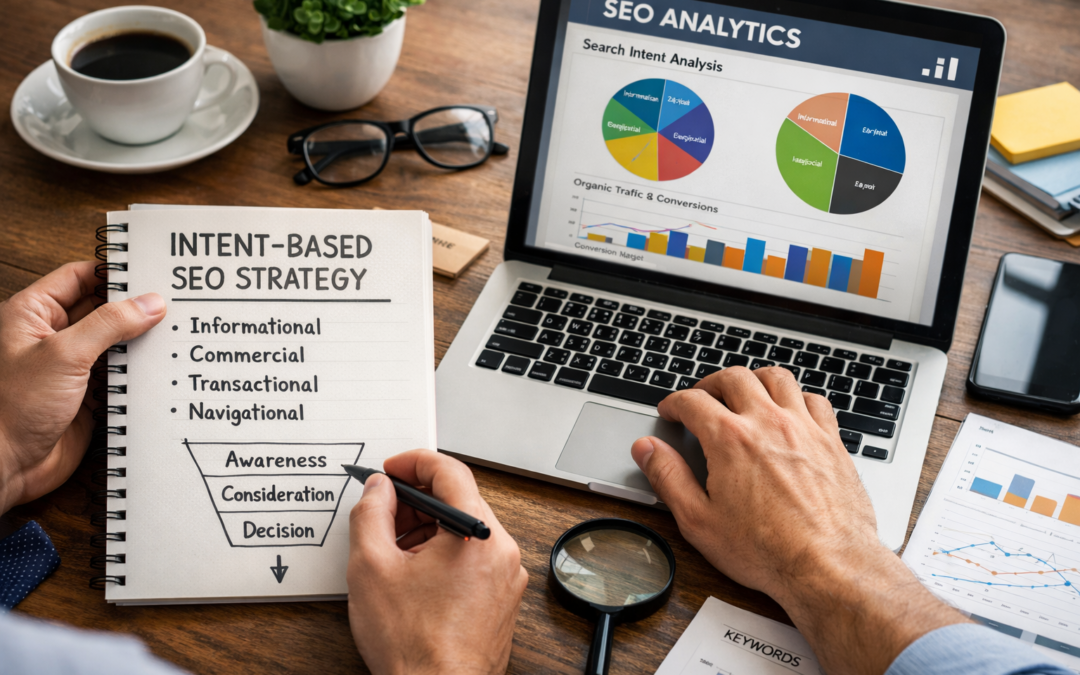
Search engine optimization has evolved far beyond keywords and backlinks. Today, successful SEO strategies focus less on rankings alone and more on understanding why users are searching in the first place. This is where intent-based SEO becomes essential.
An intent-based SEO content strategy aligns your content with the specific goals, needs, and readiness of your audience. When executed correctly, it does more than drive traffic. It attracts the right visitors and moves them closer to conversion.
This guide breaks down how to build an intent-based SEO content strategy that improves both visibility and results.
What Is Search Intent and Why It Matters
Search intent refers to the purpose behind a user’s query. Someone searching “what is digital marketing” has a very different goal than someone searching “digital marketing agency near me.” Treating both queries the same leads to mismatched content and poor performance.
Search engines prioritize content that best satisfies intent. When your content aligns with what users actually want, you see higher rankings, longer time on page, lower bounce rates, and stronger conversion signals.
There are four primary types of search intent:
- Informational: Users are looking to learn or understand something.
- Navigational: Users want to reach a specific website or brand.
- Commercial investigation: Users are comparing options before making a decision.
- Transactional: Users are ready to take action or purchase.
An intent-based SEO strategy intentionally maps content to these stages instead of relying solely on high-volume keywords.
Step 1: Identify Intent Behind Your Target Keywords
Keyword research is still foundational, but intent analysis must come first. High search volume means little if the traffic does not match your goals.
Start by analyzing the search engine results pages for your target keywords. Look at:
- The types of content ranking on page one
- Content format such as blogs, videos, product pages, or guides
- The language used in titles and meta descriptions
If Google is ranking how-to guides and explainer articles, the intent is informational. If product pages and service pages dominate, the intent is transactional or commercial.
Group keywords not only by topic but by intent category. This ensures that each piece of content has a clear purpose and audience readiness level.
Step 2: Map Content to the Buyer’s Journey
Intent-based SEO works best when paired with a clear understanding of the customer journey. Each stage requires a different type of content.
At the awareness stage, users are identifying a problem or opportunity. Content here should educate and provide clarity. Examples include blog posts, beginner guides, and definitions.
At the consideration stage, users are exploring solutions. This is where comparison content, case studies, and in-depth guides perform best.
At the decision stage, users are ready to act. Service pages, product pages, demos, and testimonials support transactional intent.
Mapping your content across these stages helps prevent gaps where traffic enters your site but has no clear next step.
Step 3: Create Content That Fully Satisfies Intent
Once intent is defined, your content must deliver exactly what the user expects and then go a step further.
For informational intent, this means clear explanations, structured formatting, and thorough answers. Avoid sales-heavy language too early, as it can undermine trust.
For commercial investigation intent, transparency is critical. Highlight benefits, limitations, comparisons, and real-world use cases.
For transactional intent, remove friction. Make it easy to convert with clear calls to action, trust signals, and concise value propositions.
Search engines increasingly reward content that demonstrates depth, relevance, and user satisfaction. Thin content rarely performs well in an intent-driven landscape.
Step 4: Optimize for Semantic Search and Context
Search engines no longer rely on exact-match keywords alone. They interpret context, relationships, and meaning.
To support intent-based SEO:
- Use related terms and natural language variations
- Answer follow-up questions within the same piece of content
- Structure content with clear headings and logical flow
This approach improves topical authority and helps your content rank for a wider range of relevant queries without keyword stuffing.
Internal linking also plays a key role. Link informational content to consideration and decision-stage pages to guide users naturally through the funnel.
Step 5: Align SEO Metrics With Conversion Goals
Traditional SEO metrics like rankings and traffic are no longer enough. Intent-based strategies require deeper performance analysis.
Track metrics such as:
- Engagement time by intent category
- Conversion rates from organic traffic
- Assisted conversions across the funnel
- Content drop-off points
This data reveals which types of intent drive real business outcomes. It also helps refine future content planning based on what actually converts.
SEO and conversion optimization should work together, not in isolation.
Step 6: Continuously Refine Based on User Behavior
Search intent is not static. User expectations change, competitors evolve, and search engines update how they interpret queries.
Regularly review top-performing pages and underperforming ones. Ask:
- Is the intent still the same?
- Does the content still match what users want?
- Are there new formats or angles dominating search results?
Refreshing content to better match current intent often delivers faster gains than creating new pages from scratch.
Why Intent-Based SEO Drives Better Results
Intent-based SEO bridges the gap between traffic and revenue. Instead of chasing visibility alone, it focuses on relevance, timing, and usefulness.
Brands that adopt this strategy see stronger alignment between content and conversions, improved trust with their audience, and better long-term SEO performance.
When you stop optimizing for keywords and start optimizing for people, search engines follow.
Final Thoughts
Building an intent-based SEO content strategy requires more upfront thinking, but the payoff is substantial. By understanding why users search, aligning content with their journey, and measuring success beyond rankings, you create a system that supports both growth and conversions.
SEO is no longer about being found. It is about being chosen.