
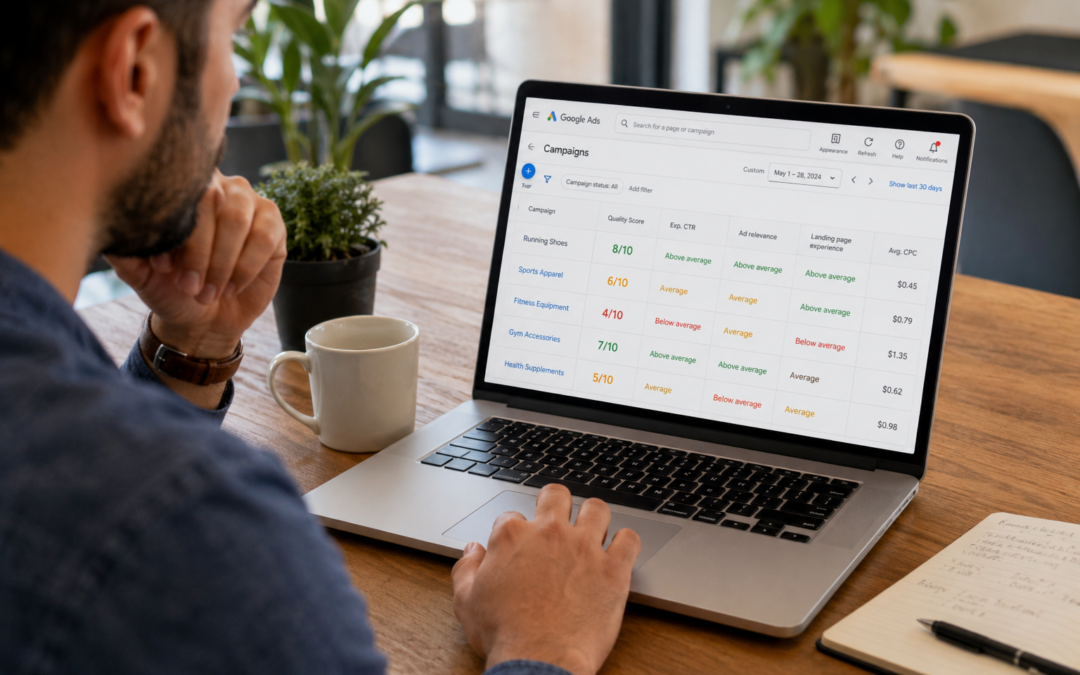
Two businesses can bid the same amount on the same keyword and pay very different costs per click. Google Ads quality score is usually why.
This post covers what quality score actually measures, how it connects to what you pay, and what to do to improve it over time.
What Google Ads quality score actually measures
According to Google Ads Help, quality score is calculated from three components: expected click-through rate, ad relevance, and landing page experience. Each keyword receives a score on a 1 to 10 scale.
This score is a diagnostic signal, not a vanity metric. It exists to show how an ad’s quality compares with other advertisers competing for the same search.
Quality score works best as a tool for understanding ad quality, not something to chase for its own sake. The number matters because of what it reflects, not because of the number itself.
How quality score connects to what you actually pay
Quality score is not a direct input in the auction that decides which ad wins a given search. Instead, it feeds into ad rank, which combines with your bid to determine both position and cost.
A higher quality score can lower cost per click for the same ad position, since a stronger score reduces how much bid strength is needed to win that spot.
This is why two advertisers bidding the same amount can end up paying noticeably different prices. The one with the higher quality score is often paying less for the same visibility.
The three components that build your score
Expected click-through rate reflects how likely an ad is to be clicked when it is shown, based on past performance for that keyword. A pay-per-click (PPC) account with a strong click history on a keyword tends to hold an advantage here over one just starting out.
Ad relevance measures how closely an ad matches the intent behind a search. A PPC ads agency structuring tightly themed ad groups is largely working to strengthen this exact component.
Landing page experience covers how relevant and useful the page is for someone who clicks the ad. A mismatch here can undercut strong ad copy and targeting.
What this looks like in practice for a PPC account
In practice, this pattern shows up often. An account was spending steadily but showing a consistently low quality score across its top keywords.
A closer review found the ad copy was strong and closely matched search intent, but the landing pages sent every click to a general product category page instead of the specific product being advertised.
Once ad copy and landing pages were aligned to the same specific offer, quality score improved across the account, and cost per click dropped for several of the highest-spend keywords. The account also saw click-through rate climb on its top keywords within a few weeks, which reinforced the improvement over time.
What to measure to improve quality score over time
Quality score by keyword is worth reviewing regularly, since account-level averages can hide a handful of keywords dragging down overall performance.
Click-through rate trend is the second signal. A keyword with declining click-through rate over time usually points to ad copy that no longer matches what people are searching for.
Landing page relevance rounds this out. Steady, gradual improvement over several weeks is the realistic expectation here, not a sudden jump in score.
Frequently asked questions
Advertisers tend to ask similar questions once they notice quality score affecting their account.
What is a good Google Ads quality score?
There is no single universal target, but scores in the upper half of the 1 to 10 scale generally reflect stronger ad quality relative to competing advertisers on the same keyword.
Can quality score change quickly?
It updates continuously, but meaningful shifts usually take time to show up, since the score reflects performance built up over recent searches rather than a single change.
Does quality score affect ad position, not just cost?
Yes. Quality score feeds into ad rank, which determines both position and cost, so a stronger score can improve visibility as well as lower cost per click.
What’s the fastest way to improve quality score?
Aligning landing pages more closely with ad copy and keyword intent is often the quickest lever, since mismatches here are usually the easiest to identify and fix.
Key Takeaways
– Google Ads quality score is built from expected click-through rate, ad relevance, and landing page experience.
– Quality score is not a direct auction input, but it shapes ad rank, which affects both cost and position.
– A higher quality score can lower cost per click for the same ad position.
– Landing page alignment is often the fastest lever for improving a weak score.
Know exactly what your ad spend is buying
If your cost per click keeps climbing even though your bids haven’t changed, quality score is often part of the reason why. Get an Audit to see exactly what’s shaping your costs and where the easiest improvements are.
